How to become an early childhood teacher
A step-by-step career guide to the qualifications you need, study pathways available and registration requirements.
Quick facts
What do I need to study?
A Bachelor of Early Childhood Education
How much can I earn?
$1,660 per week*
What’s the job market like?
Strong demand**
Is this career a good fit for you?
You’re a great fit for early childhood teaching if you:
- Have always had a strong connection with babies, toddlers and young children
- Have a caring and patient nature, even during moments of noise and chaos
- Enjoy explaining the “why” behind everyday life in simple, inspiring language
- Can think creatively on the spot (and enjoy doing so)
- Feel excited about shaping the minds of young learners
- Are the baby magnet at family and friends’ gatherings involving children
How to become an early childhood teacher
Undergraduate pathways to becoming an early childhood teacher
If you haven’t completed university study before, you will need to:
- Choose and complete the pathway that best suits your level of experience below.
- Apply for and complete a Bachelor of Early Childhood Education.
- Register to become accredited with the state or territory you wish to teach in.
Pathway Option 1: Open Access | Pathway Option 2: Undergraduate Certificate | Non-Pathway Option: Bachelor Degree |
Ideal if you: - Don’t have an ATAR. - Want to see how you handle a small amount of study to begin with. With this pathway option, you’ll gain entry into a Bachelor of Early Childhood Education by successfully completing Open Access single subjects first. | Ideal if you: - Meet little to no entry requirements. - Want to achieve a standalone certificate to begin with. With this pathway option, you’ll gain entry into a Bachelor of Early Childhood Education by completing an undergraduate certificate first. | Ideal if you: - Already have the required ATAR score listed on the course page you are interested in. - Want to get started with a full degree straight away. With this option, you’ll apply for entry into a Bachelor of Early Childhood Education using your existing ATAR or relevant academic experience. |
Postgraduate path to becoming an early childhood teacher
If you completed university study in a different field before deciding to become an early childhood school teacher, you will need to:
- Complete a Graduate Diploma of Education (Early Childhood) or Master of Teaching (Early Childhood Education).
The course type you need to qualify will depend on which state or territory you wish to teach in. Read our FAQs below for more information. - Register to become accredited with the state or territory you wish to teach in (if required for early childhood teachers in your specific region).
Your undergraduate course options

Undergraduate Certificate in Teaching Education Studies
UndergraduateCUR-HTE-CTF
Work towards your future in early childhood teaching
Study 4 core subjects in teaching children—and get entry and credit in Curtin’s Bachelor Degree. Topics include language, literacy, and curriculum. Start thinking about your career as a professional early childhood or primary educator.
- Study method
- 100% online
- Duration
- 6 months full time or part time equivalent
- Entry requirements
- No ATAR required. Start with a subject.
Bachelor of Education (Early Childhood Education)
UndergraduateCUR-ECE-DEG
Comprehensive pre-service teaching preparation
Enter the valued profession of early childhood teaching and child care. Study core subjects, professional studies and electives to be qualified to teach children aged 0-8 years in early learning centres and in junior school settings.
- Study method
- Online & on-campus
- Duration
- 4 years full time or part time equivalent
- Entry requirements
- No ATAR required. Start with a subject.

Bachelor of Education (Early Childhood)
UndergraduateUSQ-BEC-DEG
A flexible and industry engaged ECE degree
Prepare to educate in early learning centres, kindergartens and primary school classrooms. You’ll get to know the young student and how they learn. Explore teaching and curriculum for the early years. Includes professional experience.
- Study method
- Online & on-campus
- Duration
- 4 years full time or part time equivalent

Bachelor of Education (Early Childhood/Primary)
UndergraduateSCU-ECP-DEG
Double your options to work with young learners
From play to personal development, subjects in this degree prepare you to teach young and school aged children. Study the fundamentals of literacy and numeracy. Delve into science and art. Professional placements help you put theory into practice.
- Study method
- Online & on-campus
- Duration
- 4 years full time or part time equivalent
Your postgraduate course options

Graduate Diploma of Early Childhood Teaching
PostgraduateSWI-ECT-GDI
An accredited and accelerated teaching course
Add this teaching qualification to your prior studies and experience–and become an early childhood or kindergarten teacher. Take part in professional placements in settings with children aged 0-5 years. You’ll explore how they learn and play.
- Study method
- Online & on-campus
- Duration
- 1 year full time or part time equivalent
Master of Teaching (Early Childhood Education)
PostgraduateCUR-MTE-MAS
Master the art of teaching children
Master advanced critical skills for teaching the needs of 21st century learners. Consider culture and diversity and draw on theory and research. Learn to lead and practice professionally in schools. Manage early childhood education and care centres.
- Study method
- Online & on-campus
- Duration
- 2 years full time or part time equivalent

Master of Teaching (Early Childhood and Primary)
PostgraduateACU-TEC-MAS
Bring your love of learning to the classroom
Focus on creating a great environment to support childhood learning. Become a passionate advocate for the rights of children. Explore the ways that you can help children to build knowledge, skills and positive attitudes.
- Study method
- Online & on-campus
- Duration
- 2 years full time or part time equivalent

Master of Teaching (Birth - 5)
PostgraduateFLI-TEA-MAS
Become an early childhood teacher in just 2 years
Focus on education in those pivotal years in the lives of children—and make a real difference. Study teaching online, from anywhere in Australia, and complete placements in your hometown. Join the in-demand profession of early childhood teachers.
- Study method
- Online & on-campus
- Duration
- 2 years full time or part time equivalent
What does an early childhood teacher do?
Early childhood teachers are formative figures in young children's lives, shaping and caring for those between the ages of 0-5 or 0-8 years old, depending on the course taken.
Not only will you care for the young children in your classroom, you’ll be empowering their parents to work outside of the home – a crucial role in today’s society.
Daily tasks
- Interact and cognitively stimulate infants, toddlers and young children according to their own unique levels of development and curiosity
- Handle the physical wellbeing of children during the hours of care, which may include bottle feeding, changing nappies, feeding food, consoling and soothing
- Plan and carry out developmentally appropriate activities that allow the children in your care to learn through doing and playing
- Provide updates to the parents of the children in your care – including how they have eaten, slept and interacted during the day
- Collaborate with colleagues to improve the learning environment on offer within your classroom
- Create and carry out lesson plans according to Early Years Learning and Development Frameworks, changing your approaches when necessary

Salary, career growth and job outlook
Average salary
Early childhood teacher salaries vary depending on your state or territory, years of experience, and whether you work in long day care, kindergarten or a school setting.
Here’s a snapshot of average salary ranges by location. For a full breakdown, read our guide to early childhood teacher salaries in Australia.
State or territory | Average salary for early childhood teachers |
|---|---|
Victoria | $90,000-$95,000 |
New South Wales | $80,000-$95,000 |
Australian Capital Territory | $75,000-$85,000 |
Queensland | $90,000-$105,000 |
Northern Territory | $105,000-$115,000 |
Western Australia | $85,000-$100,000 |
South Australia | $85,000-$95,000 |
Tasmania | $85,000-$100,000 |
Career growth
Early childhood teaching isn’t a static role. Here's the typical trajectory your career could follow. If you're interested in other, more specialised roles like research or early intervention, read our guide to early childhood career pathways.
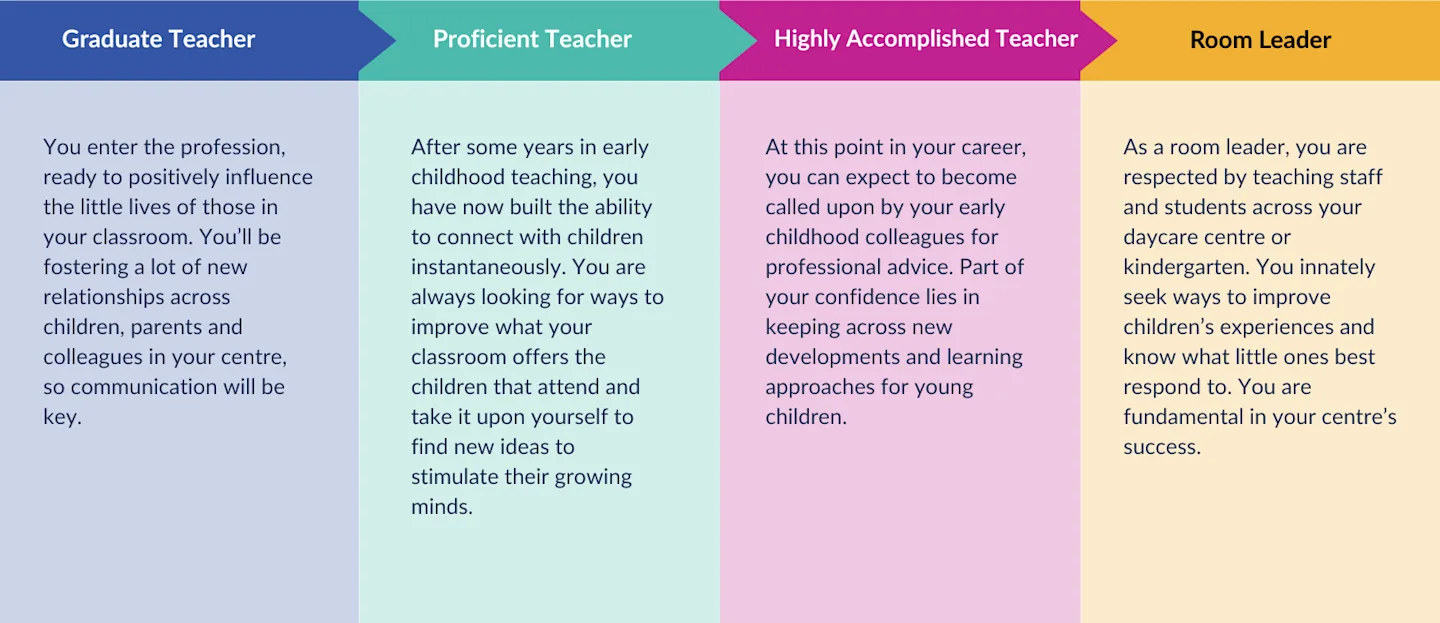
Job outlook
There’s steady demand for early childhood teachers across Australia. 5,000 new jobs** were created in the past year alone.
With more families accessing early learning services, increased workforce participation, and a growing awareness of how important the early years are for development, demand for qualified teachers only continues to go up.
Your skills are likely to be needed in many communities.
Governing bodies and accreditation
The level of accreditation you need depends on the state or territory you wish to work within, as well as the job level you wish to apply for.
Early Childhood Teachers (ECTs) generally need to hold teaching accreditation, while Early Childhood Educators (ECEs) often do not. Childcare centres generally have both roles available.
Tasmania, Queensland, and the Northern Territory are the remaining jurisdictions where ECT registration in early childhood education centre settings is not yet required. However, registration is still required if you intend to work in schools.
- Victorian Institute of Teaching (VIT)
You must register through the VIT if you would like to gain an ECT role in Victoria. - NSW Department of Education
You must register through the NSW Department of Education if you would like to work as an ECT in NSW. - Australian Capital Territory Teacher Quality Institute
ECT registration is currently voluntary in the ACT. More information can be found on the Teacher Quality Institute website. - Queensland College of Teachers
In Queensland, you are not required to register as a teacher in the state to work as an ECT. - Teacher Registration Board of the Northern Territory
The Northern Territory is currently reviewing the requirements of whether ECTs must gain registration as a teacher. More information can be found at Have Your Say. - Teacher Registration Board of Western Australia
In Western Australia, all teachers, including ECTs, must register with the Teacher Registration Board of Western Australia to work. - Teachers Registration Board Tasmania
In Tasmania, you are not required to register as a teacher in the state to work as an ECT. More information can be found on the Tasmanian Government website. - Teachers Registration Board of South Australia
You must register with the Teachers Registration Board of South Australia when working as an ECT in Tasmania, even if you have only undertaken a 3-year degree, as opposed to the 4-year degree which was historically the only qualification type requiring registration. More information can be found on the Teacher Registration Board website.
For more information, read our full guide to early childhood teacher registration.
Sources (accurate as of February 2026):
Salary data is sourced from SEEK job postings and may not fully capture all salary trends across the sector
* Median weekly salary according to the Australian Government's Jobs and Skills website
**Demand according to Skills Priority List Findings Education Professionals ANZSCO Sub-Major Group 24
FAQs about becoming an early childhood teacher
How do I become an early childhood teacher?
There are many pathways to become an early childhood teacher, particularly through Open Universities Australia. Depending on your study history, you may be able to get started with a Bachelor of Early Childhood Education right away.
Alternatively, if you do not have an ATAR, you can choose a pathway option such as Open Access – which allows you to start with single subjects that do not have entry requirements.
There is also the option of an undergraduate certificate, which is a 6-month qualification with minimal to no entry requirements. Both pathway options allow you to progress into the bachelor degree after successful completion.
Which early childhood qualification is accepted in my state?
Recent government changes mean the one-year Graduate Diploma of Education (Early Childhood) is no longer recognised on its own as an initial teacher education qualification in most states. To register as an early childhood teacher across Australia, you’ll generally need to complete a full Master of Teaching (Early Childhood Education). The exception is Western Australia, where requirements differ.
Because the rules continue to evolve, it’s worth checking in with your chosen university before you enrol. They’ll confirm exactly what applies where you plan to teach.
If you’re not looking for teacher registration, the graduate diploma can still open doors. It may qualify you for a role such as early childhood educator, which can be a great way to gain experience and work in early learning settings.
What are the required skills for early childhood teachers?
Early childhood teachers must be patient in nature – able to handle high stimulation environments with grace and ease. Being creatively-minded is also a benefit, as you’ll be looking for new and exciting ways to explain the world around you to children every day.
Is there a demand for early childhood teachers in Australia?
There is a skills shortage in early childhood, with great demand prospects across Australia. In fact, 5,000 jobs were posted in the past year alone.
Can I study early childhood education online?
Absolutely. Early childhood education courses are increasingly popular in online learning. Study and assessments are completed wholly online, while practical experience is undertaken during in-person placements. These are organised through the university you wish to study with.
Learn more about how early childhood education placements work.

Need help making study choices for your career?
Our student advisors will turn your aspirations into a clear study path.
They'll help you with:
- Choosing and enrolling in the right course for your desired career, including pathway options.
- Mapping a study plan that allows you to balance work and home commitments.
- Understanding eligibility for funding, including HECS-HELP loans.
Get unbiased advice at no cost today.
Looking for other ways to start the conversation? Contact us
Step up your career with these resources

How long is an early childhood education course?
Joshua Paleologou, our student advisor specialising in education and teaching courses, shines a light on just how long you need to study to work in early childhood education. Over to you, Joshua.

Early childhood teaching scholarships in Australia
Scholarships and financial support could help you pursue your dreams in early childhood education. Here's what you need to know about the government and university programs available to you in 2026.

Early childhood teacher registration in Australia
Taking the next step towards becoming an early childhood teacher can feel big, but you don’t have to do it alone. Here we explain how registration works in each state, and what support is available to you as a student.

Can early childhood educators teach in primary schools?
We asked Joshua Paleologou, our student advisor specialising in education and teaching courses, whether you can teach in both a primary school setting and a daycare setting once you’re qualified.