A day in the life of a primary school teacher
By Chloe CannPublished on
Ever wondered what a typical day looks like for a primary school teacher? From early starts and lesson prep to playground duty and parent meetings, two educators share what really goes on behind the classroom door.
What does a primary school teacher do each day?
Despite teaching in dramatically different environments, one a fast-growing metropolitan hub in New South Wales, the other serving bus-in students from across a sparsely populated district in remote South Australia, primary school teachers Amy Renshaw and Gina Jordan have a similar structure to their school days.
A typical school day
Both teachers have between four and five hours of face-to-face teaching a day, plus recess and a lunch break, though on some days they handle yard duty.
At least twice a week they receive scheduled time during the school day to do admin such as plan lessons, or mark or prepare assessments. This time is known as ‘NIT’ (Non-Instruction Time), ‘RFF’ (Release from Face-to-Face) or ‘DOTT’ (Duties Other Than Teaching).
Beyond the classroom
Aside from face-to-face teaching time, and the time allotted for planning, marking and admin, there are other aspects built into an average day for a primary school teacher.
“Beyond the teaching, there's a lot of emotional support, relationship building, and teamwork with colleagues,” says Gina, who teaches Year 2 at Ceduna Area School, which is in a remote town on the edge of the Nullarbor.
Daily responsibilities
On any given day a primary school teacher might:
- Create lesson plans
- Guide discussions and supervise work in class
- Prepare, administer and mark projects, tests and assignments to evaluate students' progress and record the results
- Discuss individual problems and progress with parents and students and seek advice from senior teachers or student counsellors
- Maintain discipline in classrooms and other school areas
- Participate in staff meetings and educational workshops and conferences
- Liaise with parents and business and community groups
- Maintain class and scholastic records
- Perform extracurricular tasks such as assisting with sport, excursions, school concerts and special interest programs
- Supervise student teachers on placement
Learn more: How to become a primary school teacher
Subjects taught in primary schools
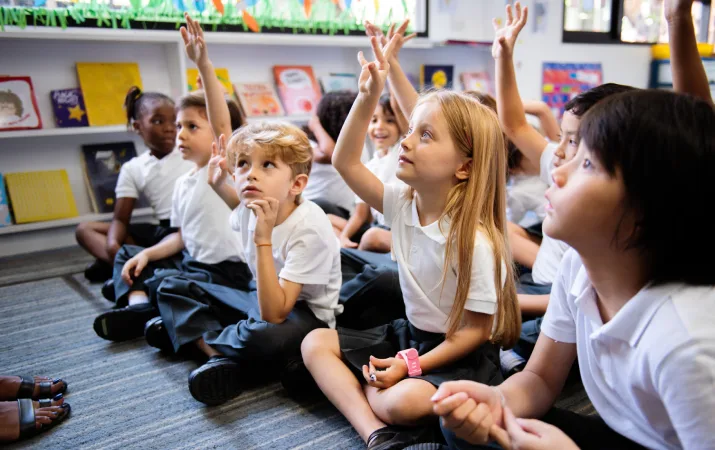
Unlike secondary school teachers, who are subject specialists, primary school teachers are tasked with teaching all Key Learning Areas using a prescribed curriculum, which typically includes:
- English (literacy)
- Mathematics (numeracy)
- History
- Geography
- Civics and culture topics
- Science
- Digital technologies / basic coding
- Visual arts
- Music
- Drama and/or dance
- Health and personal development
- Physical education / sport / fitness
- Languages (sometimes taught by a specialist)
Your daily schedule: from roll call to reports
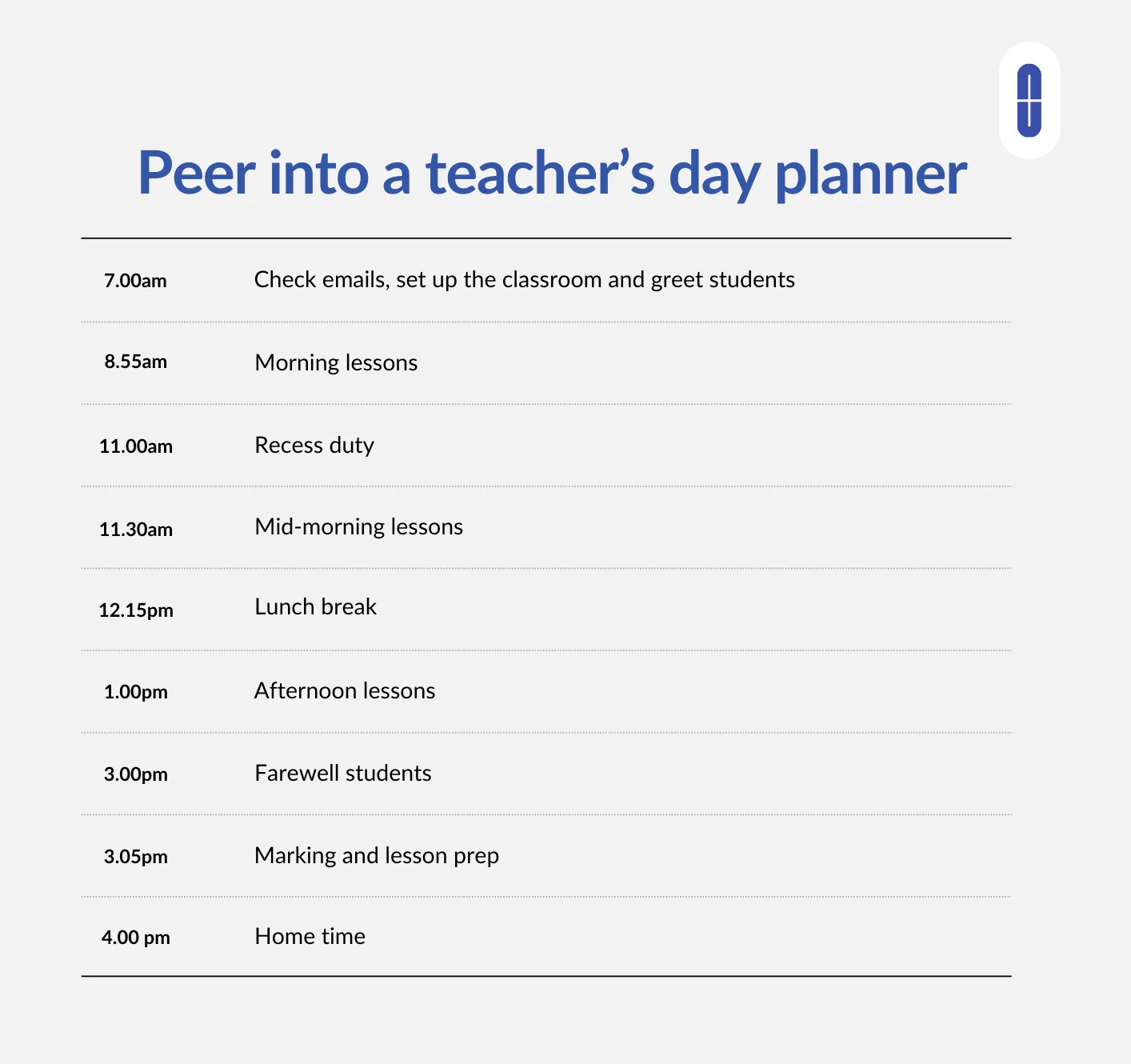
7.00am-8.55am
Before school
Year 5 teacher Amy Renshaw starts her day well before the school bell at Riverbank Public School in Sydney’s northwest. It’s one of the largest public schools in the country, with more than 2,000 students and 140 members of staff.
“I tend to get in around 7, 7.30. I will generally check emails, any morning updates from executives, and make sure I’ve got all my programs and documents ready for the day.”
Primary teacher Gina begins her day more than 2,000 kilometres away at Ceduna, which is classified as a ‘Very Remote’ school, and has a student body of some 400.
“I get to school early, just before 8, to set up the classroom, organise resources and make sure the day’s lessons are ready to go,” Gina explains. “A lot of the kids will walk in at 8.15, 8.20. We've got a breakfast club that starts at 8.30, so they can go and get breakfast, then come back into the classroom and they might sit, eat and read. There's a great amount of energy greeting them as they walk in, checking in on how they're feeling and getting everyone ready for the day."
8.55am-11.00am
Morning lessons and recess
Both teachers follow structured timetables, with lessons changing slightly each day.
“Normally we have a two-hour morning session, say we do English and maths, then we have recess,” Amy says. “We might have a duty at recess or lunch; generally, we each do two or three duties a week.”
11.30am-1.00pm
Midday to afternoon lessons
“We come back for another hour and 45 minutes, and we'll have another two sessions,” says Amy. “So it could be another English lesson, it could be geography, science, art. We have lunchtime for about 45 minutes, and then there's another hour-long session before the students get dismissed.”
3.00pm-4.00pm
After school
“I tend to just spend the afternoon catching up on any marking or getting prepped for the next day and making sure I've got printing done; things like that,” says Amy. “I tend to go home around 3.30, 4 just depending on the day.”
It’s a similar story for Gina. “We normally hang around after school for a bit to touch base with colleagues, reflect on some of the lessons [and talk about] what we're going to set up for tomorrow. But I don't often stay till five or anything like that.”
Extra commitments
Both teachers have just one official staff meeting a week after hours. During that time, staff will discuss a wide range of different issues, such as upcoming school events, curriculum planning, assessment and reporting requirements, student wellbeing and support needs, changes to school policies, training, and sharing of teaching strategies or resources.
Other occasional after-school commitments include twice-yearly parent-teacher interviews, though these are, of course, counted within the 38-hour work week.
Balancing teaching and admin duties
Managing your time and workload as a teacher is arguably one of the most challenging aspects of the job.
The maximum face-to-face teaching load for primary teachers is around 22 hours a week, and the rest of a teacher’s 38-hour work week is dedicated to planning, marking, meetings and other admin duties.
Making the most of non-teaching time
“We have Non-Instruction Time,” says Gina, “which is when another teacher will come in and teach a subject I’m not responsible for. So that's your time to do admin, which is so useful. We love that time. I work four days a week and I think I have five NIT periods throughout the week, so not every day, but some days I've got a double.”
More flexibility for early career teachers
Amy also highlights that in most Australian states and territories, early career teachers (usually defined as those within their first two years of their career) are given more RFF time than experienced teachers, to help reduce the risk of burnout and to provide extra support while they’re still learning on the job.
At a minimum, teachers are legally entitled to four hours of paid breaks a week, which leaves around 12 contracted hours a week to dedicate to non-instruction.
Is primary school teaching hard?
‘Demanding yet rewarding’ tends to be the general consensus on teaching. The challenges can vary greatly, notes Gina, depending on your experience, skill set and mindset, and on your school’s culture, size and location.
Early career challenges
It’s widely recognised that early career teachers are under more stress than those who are more experienced.
Thankfully, this is now being acknowledged by state and territory governments, many of which have introduced mentoring programs and reduced teaching loads for those in the early years of their career.
And in an effort to support recruitment and retention, government-led initiatives, like the National Teacher Workforce Action Plan, have also driven positive change that benefits teachers across the board.
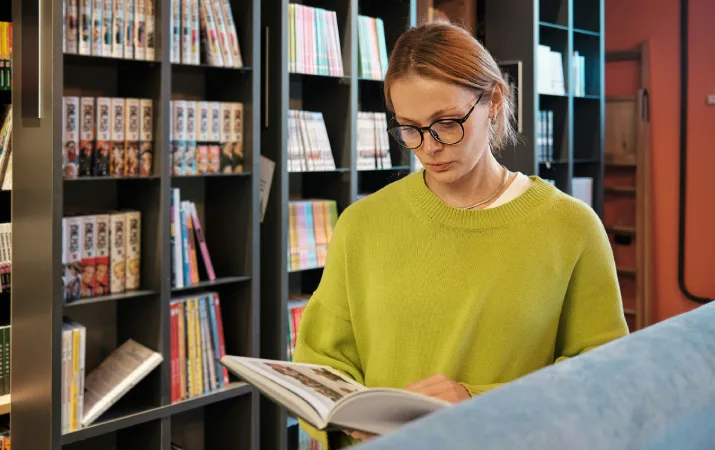
Gina notes that while the first few years present a steep learning curve, with time, experience and the right support, teachers gain confidence and learn to manage the workload more easily.
“That's the hardest time,” she says of those initial years. “I think the workload can definitely be intense: for me it was in the first few years of teaching. You just feel like you're never doing enough. Like you could always be doing more planning or marking, more refining. If the school is able to provide a mentor, which I think most schools do now, it's an absolute game changer.
“I'm now in my 11th year and over time, I've learned to set boundaries and prioritise what really matters, so my relationships and being efficient in my NITs: I've just learned to get really good at that.”
Mindset and self-management
Mindset can make a big difference too, says Gina. “Be organised, but realistic,” she notes. “You can't do everything perfectly, which is what I've learned, and that is totally fine. Focus on what has the biggest impact for your students, and lean on your colleagues. Make time for yourself outside of school.”
Personal qualities that help
Gina also points out that having certain personal qualities – such as patience, adaptability and empathy – makes teachers better equipped to handle the challenges of the job and thrive in the profession.
“You need to be resilient, because as a teacher things don't always go to plan, and you need to be able to adapt quickly,” she says. “And you might not have that straight away. I think to work in the primary years you probably need to be quite patient, curious, open-minded and have a lot of empathy. A little bit of a sense of humor is essential too.”
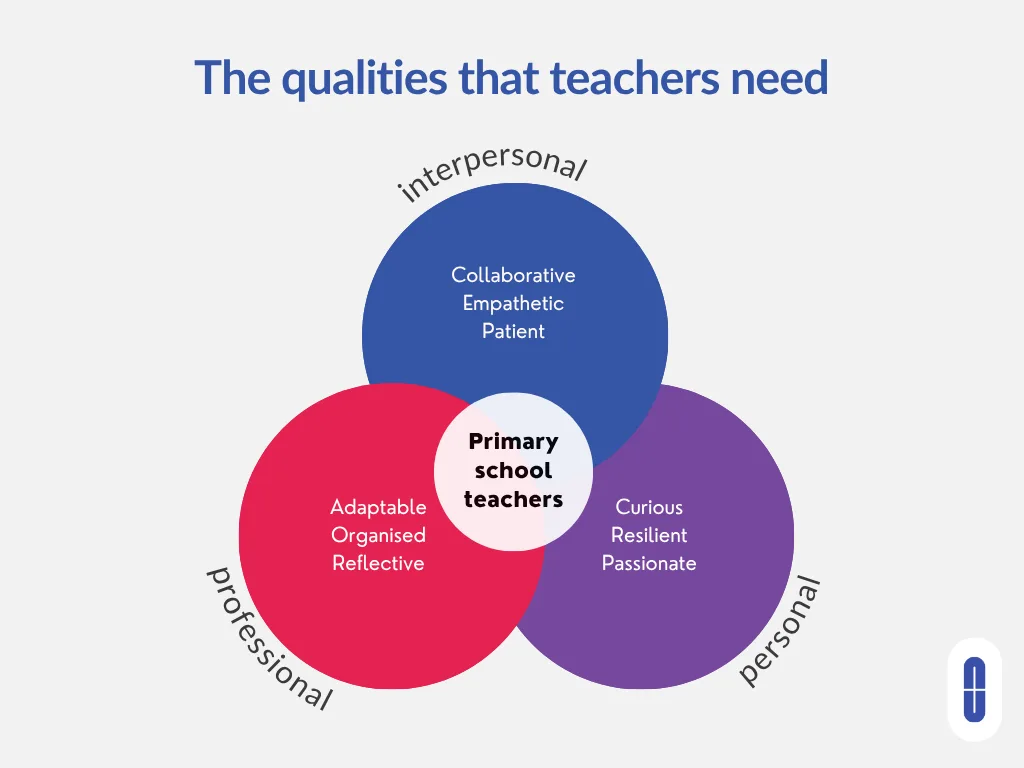
“But I also think it’s really important to reflect: take the time to think about what worked for you, what didn't, what you can do to change it up, and talk to your colleagues about that,” Gina adds. “I spend a lot of time reflecting on a learning and chatting it out with someone.”
Regarding the attributes that help teachers thrive, Amy offers: “I think someone who's well organised, passionate. And especially at my school, happy to work with other people, because we're so collaborative here, sharing ideas and doing things together so that everyone's on the same page.”
Managing diverse learning needs
One often overlooked element that teachers of all grades have to contend with is the diversity of learning needs within any one class. At Riverbank in Sydney, for example, 89% of the students have a language background other than English. And there is plenty of diversity within Gina’s class at Ceduna Area School too.
I've got a huge range of different learning needs in my class, and I'm sure every class would,” notes Gina. “Students who need additional learning support, students from a non-English speaking background, and, of course students who need extension work because they're ahead in certain areas. I always find this to be quite complex when planning.
"Though I guess, in a way, it keeps it interesting too. You've got to differentiate tasks, adapt and find ways for each child to be successful.”
Part of the reason some people find teaching hard is because they’re so passionate and invested in their students and their outcomes, notes Gina.
“A lot of teachers, I wouldn't say struggle, but put a lot of emphasis on catering to each child’s learning needs because they want every child to feel successful,” she says. “So you want to really provide that stretch for the students that need it, and then you also want to be able to fill those gaps for students on the lower end.”
Metro versus regional experiences
Gina also highlights how the differences between schools – in this case between metro and regional – can impact your day-to-day life as a teacher.
“I do find it easier out here,” she explains, “because you get to know the students on a deeper level, what motivates them, and understand their background. You get to know the families a bit more too.
"And we've got smaller class sizes. When I was working in a primary school in Adelaide, we had 40 students, but in a team teaching environment, so we were each responsible for our own 20 kids, but we team taught. Here I'm capped at 16, so it really makes a big difference; it's a nice number to work with.”
Is primary teaching a good career?
Though it can be demanding, primary teaching can prove a great career choice for those with the right attributes.
Key benefits of a teaching career
- Strong job security
- Stable hours
- A strong starting salary for a graduate role (around $79,000 minimum), with opportunities to move up pay bands as you gain experience and meet higher accreditation levels
- A clear career pathway, with opportunities to move into leadership, specialist roles, or mentoring roles
- Opportunities to take your qualification interstate or overseas
- Generous holidays
- Meaningful work with the ability to make a real difference in people’s lives
- A sense of community
- Working alongside like-minded colleagues
- The ability to work autonomously and exercise your creativity
Learn more: Do teachers get paid on school holidays?
The joy of teaching young learners
Several elements drew Gina towards primary school teaching, from the wonder inherent in little learners and the huge growth that happens in those early years, to the variety of subjects she gets to teach.
“I think the relationships we create and watching students grow in confidence, that’s what drew me to primary. You really get to see the whole child, academically, socially and emotionally,” she says.
I really love the energy and imagination of the younger students, and hearing them say that they love coming to school. In primary they're still so curious; they get genuinely excited about discovering new things with you. And I love being able to teach across all subject areas.
Cultural learning and connection
Amy also talks about how rewarding it can be to watch a child grow, and what she’s gained from working at a big school with a hugely diverse student body.
“I've learned so much from the kids about other cultures,” she says. “It's nice to get that information from the kids who are so passionate about it.”
Opportunities for growth and progression
Teaching offers far more career progression than people might realise, adds Amy, with a variety of leadership and development roles on offer.
“There are so many options,” she explains. “But also if you love being in the classroom and that's what you're passionate about, you don't have to progress any further if you don't want to. Since starting in 2019 I've expressed my desire to get into leadership to my principal, and for the last two and a bit years, she's made sure that I'm able to do professional learning focused on leadership."
“This year I've been curriculum lead of Year 5, so I help with programming, offer support, and provide feedback. And this term I've actually been relieving as assistant principal... I've definitely been given a lot of opportunities here."
How to become a primary teacher through online study
To become a primary teacher through online study, there are two main paths you can take, depending on your background:
1. Enrol in a Bachelor of Education (Primary Education)
- Four years full-time, or part-time equivalent
- An undergraduate degree available for those with an ATAR of 70 or above, or those who have done VET studies
Explore Bachelor of Education (Primary) courses
2. Enrol in a Master of Teaching (Primary Education)
- Two years full-time, or part-time equivalent
- A postgraduate degree available for those who already have an undergraduate degree
How online teaching study works
You’ll complete online theory and coursework while also undertaking professional placements in real primary schools. Online learning offers the flexibility to study at your own pace, balancing coursework around your work, family and other commitments.
There are also options to ‘fast-track’ your degree by taking subjects over the summer break, or studying extra subjects online.
For those who didn’t achieve the required ATAR, there’s still a route into teaching: the Undergraduate Certificate in Teaching Education Studies, a six-month full-time (or part-time equivalent) course that provides a stepping stone to the bachelor degree.
It’s a practical first step that builds confidence and keeps your goal of becoming a teacher firmly within reach.
Ready to start your teaching career?
Build a rewarding future inspiring the next generation.
About the author

Chloe Cann
Contributor
Chloe Cann is a Melbourne-based journalist and editor with more than a decade of experience in the industry. She holds a masters degree in journalism from a London university and has contributed to magazines, newspapers, and websites across Australia, England, Cambodia and the US, including Lonely Planet, National Geographic Traveller and Condé Nast Traveller.
FAQs about the life of a teacher
What time does a primary school teacher’s day start and end?
Teaching hours vary slightly by state and by school, but most public primary schools operate between 8.45am until 3.00pm. Teachers are, however, required to be on-site before students arrive and after they leave, often from around 8-8.15am until 3.30-4pm. Most schools also hold at least one after-hours staff meeting a week.
Contracted hours aside, many teachers report working longer, either at home or on school premises, to mark, plan lessons and write reports. According to census data, teachers in Australia work about 44 hours a week on average.
How much time is spent teaching vs admin work?
For full-time primary school teachers, face-to-face teaching hours vary depending on the state/territory and enterprise agreement, but typically hover around 21 to 22 hours per week.
Teachers are entitled to at least four hours of paid breaks weekly, which leaves around 12 contracted hours to spend on non-teaching duties such as admin, lesson planning, marking, staff meetings, yard duty, student reports, parent emails and professional development.
Do teachers get breaks during the day?
Yes. During school hours primary school teachers can take a break during recess (usually 20-30 minutes in the morning) or lunch (typically around 45–60 minutes). However, teachers are not always ‘off-duty’ during these breaks: they are often allocated to spend two or three of these breaks on playground duty a week, and sometimes they use these breaks to support students. Some teachers also use these breaks to catch up on planning, marking, checking emails or photocopying, so not all of them are true ‘breaks’.
Primary school teachers also receive at least a couple of hours of ‘relief’ or ‘RFF’ (Release from Face to Face) time per week. RFF is not a ‘break’ from work, but a break from face-to-face teaching. RFF is scheduled during the school day and dedicated to lesson planning, marking or preparing assessments.
Is being a primary school teacher stressful?
Being a primary school teacher can be both stressful and rewarding. Teachers are tasked with looking after the academic, social and emotional needs of a wide range of students, and juggle many different priorities at once, from teaching to managing pupil behaviour, providing emotional support, coordinating with other members of staff and parents, and doing admin. While teachers do enjoy long breaks, during term time they can also work long hours.
The degree of stress of course depends on many different factors, such as support available, school culture and level of experience, as well as how much your personality and natural strengths align with the realities of the job.