Do teachers get paid on school holidays?
By Chloe CannPublished on
School’s out, but teachers aren’t — here’s what really happens during the holidays.
Do teachers get paid during school holidays?
In Australia, teachers are on full pay during school holidays. Like most professionals, teachers are paid on a salaried basis, which they receive fortnightly or monthly, regardless of whether school is in session.
The only exception to this rule applies to casual and relief teachers, who are only paid for the days they work.
Understanding teacher pay in Australia
At public schools in Australia, teacher salaries are determined by state and territory enterprise agreements or national awards for public schools. The typical ranges are:
- Graduate and entry-level teachers: $79,000-$92,000
- Mid-career teachers: $111,000-$131,000
- Highly experienced/senior teachers: $123,000-$188,000
Additional allowances and incentives
Beyond their base salary, teachers can also receive additional allowances depending on their role or location.
For example, there are numerous rural or remote loading schemes, as well as incentives such as relocation support payments, subsidised travel, free housing and one-off recruitment bonuses.
And special education teachers, as well as teachers of certain subjects that are in high demand and require specialist training such as foreign languages and music, can attract additional pay through loadings or allowances.
Leadership roles
School leadership roles, such as head of department, deputy principal, or principal, also command higher salaries. Depending on school size and state, salaries for these positions can stretch from around $120,000 all the way up to $200,000-plus.
Private and independent school salaries
Salaries are not standardised at private and independent schools. Instead, each school sets its own pay scale, usually guided by enterprise agreements or individual contracts.
In most cases, private school teachers earn a similar, or slightly higher base pay, but that can vary widely depending on the school’s funding level or prestige, and any relevant additional duties.
Learn more: Teacher salaries in Australia: a pay guide by state

Do teachers get annual leave too?
No, teachers don’t get a separate annual leave entitlement like most full-time employees do; instead, their school holidays act as their leave periods. In addition to school holidays and public holidays, teachers are entitled to standard leave entitlements such as:
- Personal leave (sick/carer’s leave)
- Long service leave
- Parental leave
One major perk of teaching is the generous breaks, usually 10 to 12 weeks a year; at some private schools that can even stretch to 13 or 14 weeks each year.
The catch for those without school-aged children who are looking to get away is that the school holidays almost always coincide with peak travel season. The other downside is that many teachers spend part of that time planning, marking, or getting ready for the next term.
What teachers really do during school breaks
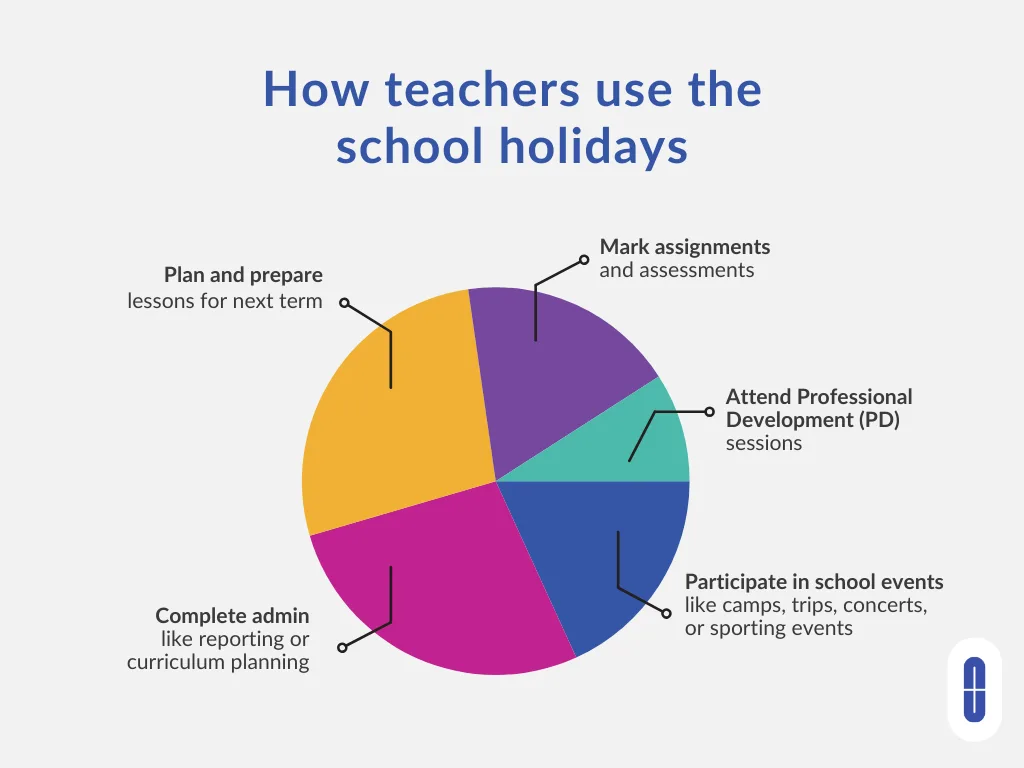
There’s a common misconception that school teachers do not work during school holidays. While school holidays are non-teaching periods, it’s common for at least part of each term break to involve work.
Different expectations for senior staff
While there’s no official expectation for primary or secondary teachers to work during the school holidays, that’s not the case for senior roles, explains Tom Smithers, who teaches STEM subjects and PE at St Margaret's Anglican Girls School in Queensland, a private Anglican day and boarding school for girls.

“Senior leaders normally have a reduced holiday load because they're expected to be at school for a certain time.”
He adds that the expectations of work during school breaks can vary and depend a lot upon the school: “It depends on what activities the school offers, and it depends on what you're willing to give back,” he says.
School camps, study sessions and co-curricular life
At St Margaret’s, Tom is involved in an array of different school-led activities during term breaks, including:
- Supervising SWOTVAC (Study Without Teaching Vacation) for Year 12 students, which is when they return to school during the holidays to prepare for upcoming exams
- Running the school’s annual Japan ski trip
- Working at athletics camps
- Volunteering for the Sony Foundation Children’s Holiday Camp.
He notes that many of these ‘out-of-hours’ activities are volunteer roles, though some sports camps at St Margaret’s do offer teachers extra remuneration.

Despite the commitment, Tom believes the return on your investment can be sizable.
From my personal experience, sometimes it’s the best way to get to know the students [and] the different staff, and you really get to know yourself and how you want to be as an educator by stepping out of the classroom into those different environments,” he says. “You're sacrificing some time and sacrificing some holiday, but what you get back, I think, is well worth it.
Public sector teachers: no holiday commitments
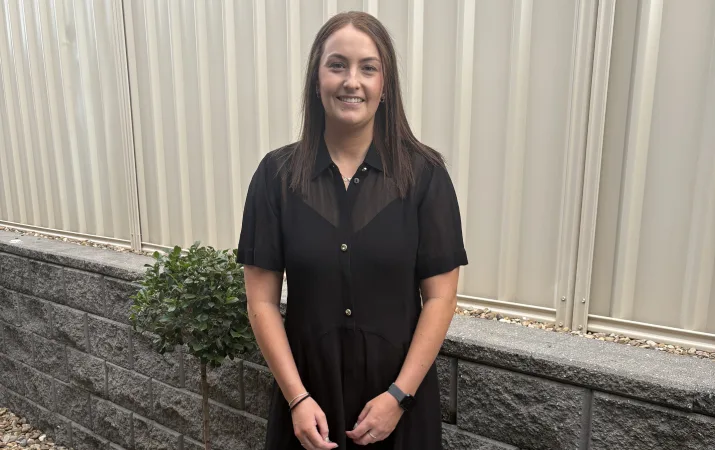
For Amy Renshaw, and Gina Jones, both primary teachers in the public sector, there are no school-led holiday activities they need to participate in.
“There are no other commitments related to school,” says Amy, who works at Riverbank Public School in Sydney, referencing both the school holidays and after-school during term time. “If there's anything happening that's related to school that's taken care of by independent contractors.”
How teachers use school holidays to catch up or get ahead
Using the school holidays to catch up or get ahead is a common theme. But the intensity and amount of work can vary a lot depending on the school, state and level of seniority, among other things.
Gina: Planning in short, focused bursts
Gina, who works at Ceduna Area School in rural South Australia, likes to set aside a small portion of time each break to work.
“I usually spend part of the time planning or preparing, but I normally do it at the start or the end of the break,” she says. “I don't spend the whole holidays doing that; not anymore. I dedicate, say, two days at the start or the end, where I just go in for the entire day. I do a good nine or ten hours just to get stuff done.”
Even when she’s taking time off, Gina admits that it’s hard to completely switch off.
“As a teacher, I find you're always thinking of new inquiries, even if you're not writing [them] down or actively researching it, your brain's always on. You might see something, and think, ‘oh, that would be a really cool thing to do with my kids’.”
Amy: Getting ahead, then enjoying the break
Amy takes a similarly balanced approach to working during the school holidays.
“I would say, generally speaking, I would probably spend one day in a holiday to get my extra admin done, if needed,” she says. “But it's not always the case. Definitely over the six-week summer break, I would say there's not much time I would be thinking about school.”
During the shorter breaks scattered throughout the year, Amy says that she might spend “half a day to a day” on schoolwork.
“I try to get a lot of it done in my admin time during my RFF (Release from Face-to-Face teaching Time). It's not like we get told at the end of the term, ‘this is what you're doing for next’. With programming, we do get told with plenty of time in advance. I like to try and get it done so I can spend most of my holidays not thinking about school.”
When the school holidays become strategic
There is, of course, a difference between needing to use the breaks to catch up and get ahead, and choosing to use that time strategically.
Turning time off into time well spent
“As middle leadership, you start to use [your holidays] in a bit more of a constructive way,” says Tom, who is a head of year at St Margaret’s.
“It isn't the case that the day that school finishes, bang, you’re on holiday, switch off, you're good to go and then you turn the switch back on again the day before school comes back. It's more about: ‘I now have this time where I don't have students knocking on my door every 10 minutes, what can I achieve? What can I get done?’
"And so whilst there is time where I do spend [the school holidays] having a break, there are other times where I want to still get the work organised so that I'm not playing catch up.”

A personal choice, not an expectation
Tom is clear that this use of time is self-driven, not school mandated.
There's no expectation that you have to be here. The school is very, very open to ‘go have your holiday, have a great time’. Personally, I want to do a good job, and so I sacrifice that time on the holidays to come in and do that work. I wouldn't say that every single teacher is like that, and I wouldn't say every single holiday is like that.
Planning ahead for shorter days
Using holidays tactically can also help teachers have shorter days during term time, notes Tom.
“There are teachers that would 100% put some time in on their holidays so that they can finish the day at 3pm, or whatever the time their school finishes, then go home,” he says. “That being said, though, whilst they might go home to their families, they might still do some work while they're at home.”
Some teachers use the summer holidays to plan the entire year ahead, he adds, while others take a term-by-term approach instead.
The need to reset
Even though getting organised over the holidays is routine for Tom, he stresses the importance of downtime.
“You need those breaks,” he says, “because teaching is a sprint. It's a sprint through the term. You need that time to relax, refresh and just reset the brain [before you] get back into it again. And that's what I tend to do.”
Thinking about teaching? Explore your study options
To become a teacher through online study, there are two main avenues, depending on your background:
- Enrol in a Bachelor of Education; four years full-time, or part-time equivalent (an undergraduate degree available for those with an ATAR of 70 or above, or those who have done VET studies)
- Enrol in a Master of Teaching; two years full-time, or part-time equivalent (a postgraduate degree available for those who already have an undergraduate degree)
You’ll complete online theory and coursework while also undertaking professional placements in real schools.
Online learning offers the flexibility to study at your own pace, balancing coursework around your work, family and other commitments. There are also options to ‘fast-track’ your degree by taking subjects over the summer break, or studying extra subjects each term.
For those who didn’t achieve the required ATAR, there’s still a route into teaching: the Undergraduate Certificate in Teaching Education Studies, a six-month full-time (or part-time equivalent) course that provides a stepping stone to the bachelor degree.
Ready to start your teaching career?
Build a rewarding future inspiring the next generation.
About the author

Chloe Cann
Contributor
Chloe Cann is a Melbourne-based journalist and editor with more than a decade of experience in the industry. She holds a masters degree in journalism from a London university and has contributed to magazines, newspapers, and websites across Australia, England, Cambodia and the US, including Lonely Planet, National Geographic Traveller and Condé Nast Traveller.
FAQs about teacher holidays
Do teachers get extra annual leave on top of school holidays?
No. Full-time teachers do not receive ‘extra’ annual leave on top of the school holidays.
Is teacher holiday pay included in their annual salary?
Yes: teachers’ salaries are annualised, meaning they are paid for the entire year, even though the school year is typically only 40 weeks long.
Do teachers work during school holidays?
Typically, yes. Teachers often use holiday time for:
- Lesson planning and preparation
- Marking assignments and assessments
- Professional Development (PD)
- School events such as camps, excursions, or concerts
At some schools, teachers are also involved in different activities during term breaks, such as school trips, camps, sporting events or concerts.
How is teacher pay structured in Australia?
Teachers are paid salaries. Teacher pay is dependent upon experience and the role, and is structured into salary bands or levels, usually set out in enterprise bargaining agreements (EBAs) or state/territory awards. Teaching specialist subjects or working in rural locations can attract additional pay through loadings or allowances.
Read more about primary school teacher salaries and secondary school teacher salaries.
What’s the difference between term-time only and annualised pay?
If you’re on ‘term-time only’ pay, you’re paid just for the weeks you actually work during school terms. Annualised pay means your salary covers the full calendar year, including both term time and school holidays.
Are teacher salaries lower because of school holidays?
No. Teachers’ salaries are annualised, so their pay is not reduced by school holidays. The ‘lower salary’ perception comes from the misunderstanding that teachers are on holiday for 10–14 weeks, when in reality the salary already accounts for those weeks.