What a teacher’s workload looks like
By Chloe CannPublished on
Teaching involves way more than time spent in front of a class. From planning and marking to meetings, admin and student support, this guide breaks down what makes up a teacher’s working hours.
Understanding the teacher workload in Australia
A teacher’s role adds up in all sorts of ways across the school week. The role involves:
- Lesson planning and adapting lessons to cater to different learners
- Creating or sourcing teaching resources
- Marking and preparing assessments
- Reporting
- Meetings with staff, students or parents
- Yard duty
- Organising excursions, assemblies or events
- Professional development
- ‘Pastoral’ care (tending to students’ wellbeing, personal development, and emotional health)
- Liaising with counsellors or support staff about students who need extra help
- Documenting incidents
- Supervising student teachers or mentoring colleagues
Primary vs secondary teaching workloads
While their responsibilities are similar on paper, the day-to-day workload of a primary and secondary teacher can look quite different. One of the key differences is the proportion of time spent teaching versus planning and marking.
Primary teachers spend more time in front of students because they usually teach the same class all day across multiple subjects.
Secondary teachers, however, have a slightly lower teaching load due to subject specialisation, a greater amount of planning, and the higher volume of assessments required for teaching different classes, across different year groups.
Where the pain points are
It’s no secret that teachers are under high workload pressures and often working longer hours than their contractual 38-hour work week.
Census data show that teachers in Australia work about 44 hours a week on average, though some estimates suggest that real number could be as high as 50 hours a week.
Some of the key stressors named in a recent OECD report are:
- The amount of administrative work
- The amount of marking
- The pressures of keeping up with curriculum changes
The government reforms set to change things up
But it’s not all doom and gloom. The same OECD report also showed 84% of teachers are ‘satisfied with their jobs’. And many changes are afoot, at both a state and a federal level, to try and address the workload pressures teachers face, such as:
- Workload Reduction Pilot Programs
- The National Teacher Workforce Action Plan (NTWAP)
- The Better and Fairer Schools Agreement (BFSA)
According to Geri Sumpter, Head of Be You mental health and wellbeing in education initiative, there’s “a lot being focused on and worked on to shift the dial” when it comes to teacher wellbeing.
Stress and burnout are concerning. We know that [a teacher’s workload] is often seen as excessive and unpaid. But I think the important thing to say is that this is definitely being recognised. For those that are coming into the sector, nowhere's ever perfect, but there's a lot of work being put in to try to effect some change and then put some support around educators.
The Better and Fairer Schools Agreement in particular could be a game changer.
“The difference with the Better and Fairer Schools Agreement is that, for the first time, it's included a focus on educator wellbeing,” Geri says. “That's a real shift and a real understanding of the fact that we need our educators to be well and supported.”
Learn more: What to expect from your work-life balance as a teacher
Contact hours, planning and admin: a closer look
Face-to-face time
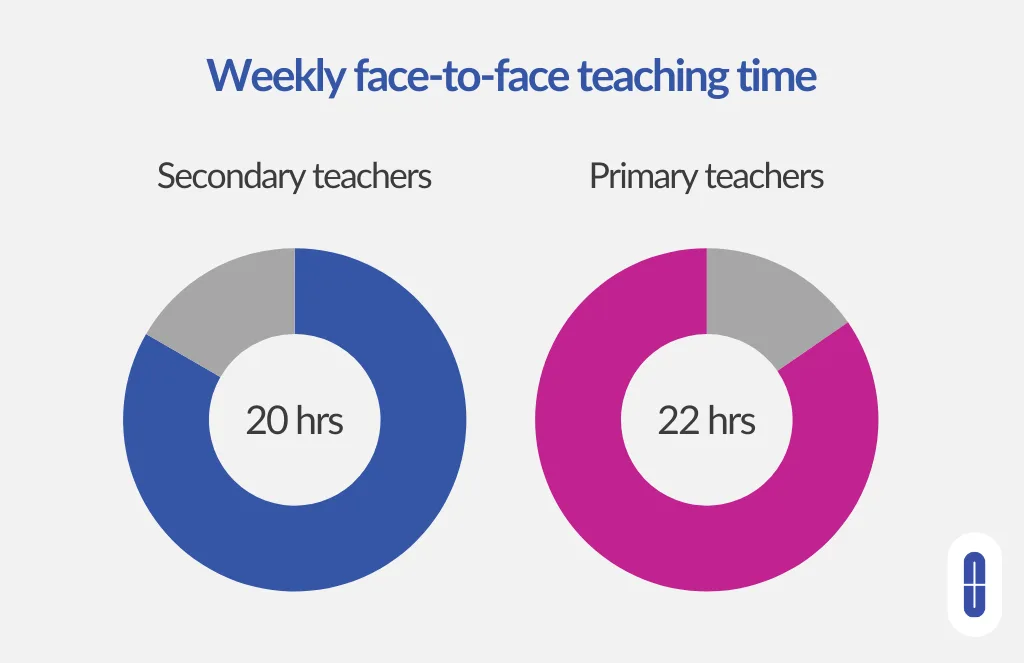
In most states and territories in Australia, the maximum face-to-face teaching load for secondary teachers is lower than for primary teachers, typically:
- Around 20 hours per week for secondary (and as low as 18.5 hours in some states, like Victoria)
- Around 22 hours per week for primary
RFF / NIT / DOTT time
During the school week, both primary and secondary teachers have access to protected ‘RFF’ (Release from Face-to-Face teaching) time, sometimes also known as ‘NIT’ (Non-Instruction Time), or ‘DOTT’ (Duties Other Than Teaching), which is set aside for tasks such as planning and marking.
Secondary teachers tend to have slightly more non-teaching time built into their timetables, typically three to five hours a week, instead of a primary teacher’s two to three hours.
A day in the life
Teachers are expected to be at school before students arrive and after they leave, meaning they often start around 8am and finish around 3.30pm, at a minimum.
A typical school day includes roughly five teaching hours, and includes a break for recess (20-30 minutes) and a break for lunch (45-60 minutes), though some days will feature RFF time and some days teachers will be required to handle yard duty.
Any other remaining time is dedicated to planning, marking and admin tasks.
Learn more: A day in the life of a primary school teacher
How workload changes with seniority
Another aspect to consider is how your workload, and the shape of your week, changes as you move into more senior teaching roles, as Tom Smithers notes.
He teaches STEM subjects and PE at St Margaret's Anglican Girls School in Queensland, and for the last five years he’s also worked as the head of a year group.
“Because I'm a head of year, which means I'm organising different types of events, meeting with a lot of students, calling a lot of parents, I teach less,” explains Tom. “So I have a lower class load, which is pretty much the standard across every single school: if you're in a middle or senior leadership your classroom load goes down depending on what your position is.”
Regardless of seniority, many teachers say the workload is demanding but also deeply rewarding – the challenge comes from balancing the admin and paperwork with the part of the job they love most: working directly with students.
Teachers’ leave entitlements
Sick leave
With the exception of Queensland (where teachers get 10 days of paid sick leave a year) all other states and territories offer permanent, full-time secondary and primary teachers up to 15 days of paid sick leave per year, and unused sick leave accumulates year to year for permanent employees.
In NSW, a teacher who starts their first appointment in the school system may be entitled to up to 15 additional days of sick leave over their first two years of service
Personal and carer’s leave
Some states offer teachers additional leave entitlements for various purposes.
In Victoria, if a teacher exhausts their accrued personal leave within the calendar year, they are entitled to an additional 22.8 hours of paid personal leave specifically for providing care or support to an immediate family or household member who requires it due to illness, injury, or an unexpected emergency.
Long service leave
Teachers enjoy long service leave entitlements that are often more generous than the standard provisions.
In SA, NT and Victoria, teachers are entitled to 13 weeks of long service leave (well over the standard 8.67 weeks) after seven to 10 years of service
Remote service leave
Those working in remote teaching roles can access additional leave entitlements and incentives.
WA, for example, offers remote teachers an extra 22 weeks of paid leave after four years of service
Parental leave
In addition to paid sick leave, remote teaching incentives and enhanced long service leave, teachers in most states and territories can access generous paid parental leave, which is offered on top of the Commonwealth Paid Parental Leave (PPL) for those who’ve completed 12 months of service.
In ACT, the birth parent can access a whopping 24 weeks of paid leave, while the non-birth parent can access 18. All other states and territories offer between 14 and 18 weeks.
Mental health support for teachers, and the schools that prioritise wellbeing
Teacher wellbeing initiatives looks different from school to school, but many are taking active steps to better support their staff.
A school leading the way: St Margaret’s Anglican Girls School
Take St Margaret’s Anglican Girls School in northeast Brisbane, for example.
The private day and boarding school for girls has been named an Employer of Choice by The Educator magazine for five consecutive years (2021 to 2025) due to positive teacher feedback and the school’s commitment to promoting staff wellbeing by prioritising professional development, promoting a sense of belonging, fostering relationships and recognising achievement.
How St Margaret’s supports its staff
The school offers teachers a range of benefits, including:
- Access to wellness initiatives such as yoga, mindfulness, and end-of-term massages
- A staff wellbeing committee that organises social events, such as cooking classes, an annual Melbourne Cup luncheon, and end of term drinks
- A weekly morning tea for staff
- Extra leave days at Christmas for support staff
- Staff awards
- Tuition discounts for employee’s children
- Access to the school pool and gym
- Additional payments for extracurricular commitments
- Financial incentives for relevant further study, such as subsidising masters degrees

A strong culture of teamwork
For Tom, the way that St Margaret’s actively encourages staff relationships and teamwork has been pivotal.
“Because I've worked with a few different schools beforehand, I can very happily say that St Margaret’s is one of the most collegiate schools I've ever worked in,” he says. “The staff work really, really hard and work really well together. Everyone has that sort of mentality here, where you want to really do your best. And the school really supports that.”
Wellbeing support beyond the school gates
Beyond individual schools, teachers can also access support through unions and national programs.
Some unions, such as the NSW Teachers Federation and Australian Education Union (AEU) offer members their own free or subsidised wellbeing services or mental health grants.
At a base level, teachers across Australia have access to the Employee Assistance Program (EAP), a confidential counselling and wellbeing service.
Although entitlements vary between states, you typically get three to four sessions per issue per year.
Free national wellbeing resources
Nationally, all teachers also have access to free online learning designed exclusively for educators through Be You, which is delivered by Beyond Blue in collaboration with Early Childhood Australia and headspace.
It covers topics such as stress management, burnout prevention, self-care, setting boundaries, and balancing workload.
Conveniently, completing these modules counts toward Professional Development (PD) hours required for teacher registration too, so educators can prioritise their own wellbeing without falling behind on PD requirements.
Ready to start your teaching career?
Build a rewarding future inspiring the next generation.
About the author

Chloe Cann
Contributor
Chloe Cann is a Melbourne-based journalist and editor with more than a decade of experience in the industry. She holds a masters degree in journalism from a London university and has contributed to magazines, newspapers, and websites across Australia, England, Cambodia and the US, including Lonely Planet, National Geographic Traveller and Condé Nast Traveller.
FAQs about the teacher workload
How many hours do teachers work per week in Australia?
Are Australian teachers entitled to sick leave?
Yes. With the exception of Queensland (where teachers get 10 days of paid sick leave a year) all other states and territories offer permanent, full-time secondary and primary teachers up to 15 days of paid sick leave per year, and unused sick leave accumulates year to year for permanent employees. Some states offer teachers additional hours of leave for various purposes.
Do teachers really get more holidays than other jobs?
Yes. Across Australia, primary and secondary school teachers enjoy around 10 to 12 weeks of school holidays each year. At some private schools, this may even stretch to 13 or 14 weeks a year. Typically, the breaks include two weeks in April, July and September, and a five- to six-week summer holiday over December and January.
While the annual holiday periods may seem generous at first glance, few teachers spend all of their breaks totally logged off from work. Professional Development (PD) days can sometimes take place over the holidays, and many teachers use at least some of this time to catch up on work.
Learn more: Do teachers get paid on school holidays?