Teacher salaries in Australia: A pay guide by state
By Zoya PatelPublished on
If you’re thinking about a career in teaching, we have all your answers covered when it comes to what you can expect from your salary.
How much do teachers get paid in Australia?
There’s no doubt that teaching is a rewarding career, and that teachers play a very important role in our society. But as well as the social rewards of a career in teaching, you might be wondering what the salary conditions for teachers are.
Teacher wages in Australia vary state by state, and depend on a few other factors, including whether you’re teaching in primary or secondary schools, your seniority level, and whether you’re in a public or private school.
On average, teachers in Australia earn between $100,000 to $105,000. Read on to see how this breaks down further. Each state/territory has an ‘award’, which sets out the government mandated rates of pay for teachers.
What graduate teachers vs experienced teachers earn
Teacher salaries start at a baseline for graduate teachers and then see an annual increase for each year of teaching. This means as you gain more experience in the industry, your salary increases.
Across Australia, you’ll have a starting salary of between $79,000 and $92,000 as a graduate, depending on your state or territory. An experienced teacher can earn between $111,000 and $131,000. You can find a full breakdown of state/territory-based teacher salaries below.
Casual teacher pay: daily rates and conditions
If you have a teaching qualification, you can also work on a casual basis as a relief teacher, which can be a great option if you want to have a varied career, or need to take a break from full-time work for caring or other responsibilities. Different states and territories again have different payment rates for casual teachers, but you will primarily be paid a ‘day rate’ between $329 and $582 a day across the country.
Casual teachers are also entitled to some leave provisions in different states and territories too, so it’s a good idea to look into the award in your state and find out the broader employment conditions that apply to casual teaching.
A good place to start is Fair Work Australia, where you can look up and calculate your pay and provisions based on the relevant award.

Primary vs secondary teacher salary differences
It can be hard to choose between teaching in primary or secondary schools, and you may need to weigh up your own preferences in terms of working with different age groups, the type of teaching you’re drawn to, and what schools in your area you’d like to teach at.
The good news is, salaries are the same across Australia regardless of which age or year level you teach. The main difference comes down to experience level, other roles/responsibilities (e.g. if you take on a senior leadership role in the school), and also location, with some incentives for teachers in remote or rural areas.
Aside from salaries, there are other factors to consider when choosing between a career in primary or secondary teaching, including classroom format, curriculum and more.
Learn more: A guide to primary school teacher salaries and secondary school teacher salaries in Australia
Public vs private school teacher salaries
Another choice to weigh up is whether you teach in a public or private school. Public schools are government owned, whereas private or independent schools may be run by community or religious organisations, and involve fees for students.
Public schools across Australia have teacher salaries and conditions set according to the state or territory award. Private schools can offer teachers higher salaries as an incentive.
As a result of this, some private schools can offer significantly higher salaries than public schools and may offer other benefits or bonuses as well. It’s worth remembering that the expectations for teachers in private schools may also require out-of-hours work and additional duties outside of their teaching, so you should take all these aspects into consideration when weighing up the two systems.
Teacher salaries by state: NSW, VIC, QLD and more
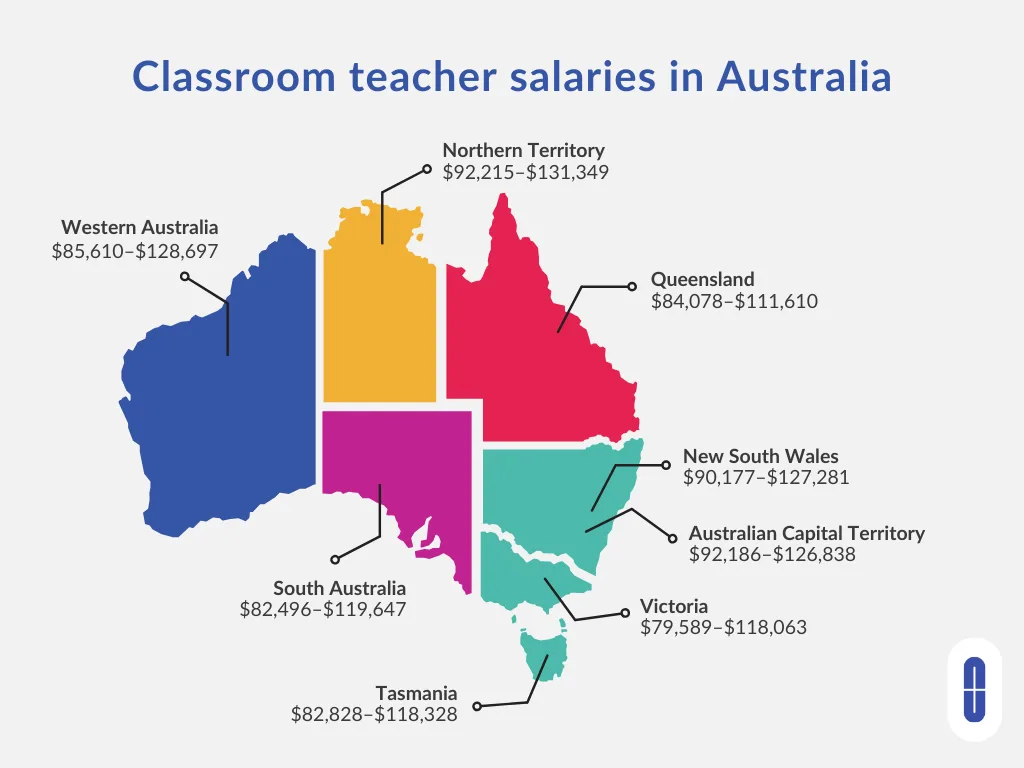
So, what does all of this actually mean for you when you start teaching in your state/territory? Here’s how salaries stack up across Australia, for classroom teachers:
What’s the average teacher salary in NSW?
In NSW, teacher salaries start at $90,177 for a graduate, and rise incrementally with an annual increase to $127,281.
NSW has also recently introduced a range of incentives and premiums specifically for teachers in rural/remote areas, including rental subsidies, retention bonuses and stamp duty offsets. You can find a breakdown of these by visiting the NSW Department of Education.
Source: NSW Department of Education, 2025
What’s the average teacher salary in ACT?
In ACT, teacher salaries start at $92,186 for a graduate, and rise incrementally with an annual increase to $126,838. This is one of the higher rates of pay across Australia, and reflects the ACT’s status as having higher salaries per capita than other states or territories.
Source: ACT Department of Education, 2025
What’s the average teacher salary in VIC?
In VIC, teacher salaries start at $79,589 for a graduate, and rise incrementally with an annual increase to $118,063.
This is the lowest rate across the country, and is reflective of a history of lower public school funding in the state, and prior conditions being negotiated for time in lieu over higher salaries, as well as other factors.
Source: Victorian Department of Education, 2025
What’s the average teacher salary in TAS?
In TAS, teacher salaries start at $82,828 for a graduate, and rise incrementally with an annual increase to $118,328.
While this salary rate is lower than most other states and territories, it’s important to note that cost of living is generally lower in Tasmania than in mainland cities.
Source: Tasmanian Department of Education, 2025
What’s the average teacher salary in SA?
In SA, teacher salaries start at $82,496 for a graduate, and rise incrementally with an annual increase to $119,647.
Source: SA Department of Education, 2025
What’s the average teacher salary in WA?
In WA, teacher salaries start at $85,610 for a graduate, and rise incrementally with an annual increase to $128,697.
The WA Award is higher than other states and territories due to the smaller population across the state, and higher demand for teachers in rural or remote areas.
Source: WA Department of Education, 2025
What’s the average teacher salary in NT?
In NT, teacher salaries start at $92,215 for a graduate, and rise incrementally with an annual increase to $131,349.
This is the highest salary range for classroom teachers in the country, and is linked to the high demand for teachers in remote areas of the Territory. The award also has specific wages for Aboriginal and Torres Strait Islander teachers, and for those working in remote First Nations communities.
Source: NT Department of Education, 2025
What’s the average teacher salary in QLD?
In Queensland, teacher salaries start at $84,078 for a graduate, and rise incrementally with an annual increase to $111,610.
Source: Queensland Department of Education, 2025

How salary increases work for teachers
Teachers are paid on a step-basis – meaning salaries increase every year based on experience, up to a certain number of years.
Each state and territory has a slightly different scale and number of steps, but generally this starts at graduate level, and has 5-8 steps. Once you reach the top of the scale, salaries remain the same unless you take on a senior role, such as a head teacher, head of department, year level coordinator or a principal/deputy principal role.
The good thing about this system is that classroom teachers can expect regular increases as their experience grows, without relying on individual performance assessments, like in other industries. On the down side, once you reach the top of the scale, you won’t see another increase in your salary without moving roles or taking on additional responsibilities.
What are the highest-paid teaching roles in Australia?
The highest paid teaching roles in Australia are principal level positions – as leaders of their schools, principals and deputy principals play an important role in setting the school culture, working with government, and managing the teaching staff, which is reflected in their salaries.
The highest salary for principals (which is also the highest teaching salary overall) is in the Northern Territory, at $205,531 at the top of the scale. As mentioned before, the Northern Territory has higher demand for teachers in remote areas, and the salary scale reflects this.
Real talk: A teacher shares their salary journey
As we’ve learned, there are a lot of different factors that define what teachers get paid – location, experience, whether you’re teaching in regional areas, it all plays a role. But what does this actually look like in practice? We wanted to share a real-world example to give you a sense of how your career might unfold, and how that impacts your salary as a teacher.
Charles McIntosh is a secondary teacher in the ACT and has seen his salary change over his decade of teaching.

I started teaching at 80% of full-time, earning about $60,000 ten years ago. I then moved to full-time and progressed up the pay-scale ladder under our Enterprise Agreement, which is publicly available for all states and territories. In the ACT, teachers who’ve been working in public education for more than 8 years currently earn about $125,000.
“Once I reached the top of the pay-scale I took on a couple of roles that bumped my pay up a little: pre-service teacher coordinator and floor warden. Probably bought me a coffee or two each week. Since then, I have become a head of faculty (called a school leader C in ACT) and am paid about $146,000.”
Charles’s experience shows just one of the potential career pathways teachers can take – moving from a part-time graduate through to a full-time school leader. Teaching can be a varied career, with opportunities to change your role, salary and outcomes along the way!
The salary information in this guide is current as of December 2025.
Ready to start your teaching career?
Build a rewarding future inspiring the next generation.
About the author

FAQs about teacher salaries
What is the starting teacher salary in Australia?
As a graduate teachers in Australia you’ll have a starting salary of between $79,589 and $92,215, depending on the state or territory you teach in.
Do teachers in private schools get paid more?
Teachers in private schools may be paid more than the standard award in their state or territory, and also can negotiate their salary, and may receive bonuses and other allowances. However, there may also be additional duties they are required to perform.
Which state pays teachers the most in Australia?
The Northern Territory has the highest award wages for teachers in Australia, starting at $92,215 for a graduate, and the top of the classroom teacher scale is $131,349.
How often do teacher salaries increase?
Teacher salaries increase annually until you reach the top of your state or territory’s scale. Salaries also increase with higher duties, such as senior teaching positions and school leadership roles.
Are there bonuses or incentives for teachers?
The conditions and allowances for teachers are set in the award for each state and territory, and include leave allowances, parental leave entitlements and so on. Private schools may also offer additional bonuses and incentives.
Teachers in remote areas can also access higher pay or incentives in different states and territories, including:
- Rent subsidies
- Stamp duty offsets
- Relocation allowances
- Retention bonuses
Do part-time teachers receive the same benefits as full-time teachers?
The conditions for part-time teachers are the same as full-time teachers but applied on a pro-rata basis, where the salary/benefits are calculated based on the percentage of hours they work of a full-time allowance.
How do I negotiate my teacher salary?
If you work in a government school, you can’t negotiate your salary, as this is set based on your level of experience according to the award. You can, however, still speak to your head teacher or principal about your career goals, and how you might accelerate your journey into leadership positions, which do have higher rates of pay.
If you work for a private school, there may be opportunities to negotiate your salary. It’s a good idea to research average salaries in private schools and understand your level of experience and what you can offer before entering negotiations.
Although it can seem daunting to have these conversations, it’s important to regularly catch up with your supervisor to talk through your goals, feedback on your performance, and to discuss how these things can be reflected in your pay.