The complete guide to ATAR requirements for teaching degrees
By Joshua PaleologouPublished on
Dreaming of becoming a teacher? Our student advisor specialising in education and teaching courses explains the ATAR you usually need for an undergraduate teaching degree – and the alternative pathways you can take if you don’t meet entry requirements.
What degree do I need to become a teacher?
So you’ve set your sights on this wonderful career. Go you! Wanting to lead the next generation is a goal to be proud of.
If you’ve never studied at uni before, you’ll need a Bachelor of Education in your teaching specialisation (either early childhood education, primary education or secondary education) before you can register as a teacher in your state or territory.
There are a few different ways to get into a Bachelor of Education, which I’ll explain below. The most direct path is with an ATAR, though it’s not the only option. Many students go on to become teachers without one – including Helene, whose story you’ll read later.
What if I’m a mature-aged student?
If it’s been a while since you studied at school or you don’t even have an ATAR, this advice may not be the most relevant place to start. Instead, I recommend you head over to our guide on how to get into uni without an ATAR.
Or maybe you’ve already completed a bachelor degree and you’re thinking about a return to study? If that’s the case, read about the Master of Teaching, which offers the simplest way to make a career change into education.
What ATAR do I need for direct entry into a Bachelor of Education in Australia?
Most universities set a minimum ATAR (Australian Tertiary Admission Rank) as part of their Bachelor of Education entry requirements for those coming straight out of Year 12. Your ATAR can range anywhere from 0.00 to 99.95, depending on your school results.
Based on the current entry requirements for 2026 intakes (including midyear), you’ll need an ATAR between 50.0 and 70.0 to apply for direct entry into a Bachelor of Education. The exact figure depends on the university you’re interested in, how many places they have available, and how many students are expected to apply. Entry scores can change slightly from year to year depending on demand and available places.
A higher ATAR doesn’t mean a course is harder – it just means the uni has fewer places to offer or is anticipating a lot of interest and needs a way to manage the number of applicants.
Minimum ATAR requirements by state and university for 2026
Below, you’ll find the current ATAR cut-offs for Bachelor of Education degrees at every university across Australia, broken down by teaching specialisation.
Keep in mind that the linked courses are available to study online through Open Universities Australia regardless of where you’re based, and that we specialise in offering other, non-ATAR pathways in.
If your score doesn’t end up being what you hoped for, or you just don’t want the pressure of worrying about it to begin with, it is possible to skip these ATAR requirements entirely. You can scroll further down for more information on this.
Australian Capital Territory university ATARs
If you’re planning to study with an ACT uni, you’ll need an ATAR above 60.0 to apply.
University | Early childhood education ATAR | Primary education ATAR | Secondary education ATAR |
|---|---|---|---|
60.0 | 67.0 | 68.0 | |
University of Canberra | 60.0 | 60.0 | 60.0 |
You’ll also need:
- to submit a Teaching Suitability Statement. This involves writing two 500-word personal statements about your interest in teaching and your leadership qualities.
- to prove you meet English language requirements (either through your Year 12 results or by completing a test).
Though it won’t block you from applying, it’s assumed you have Year 12 level knowledge in English and Mathematics. If you’re not confident you do, or you didn't recently finish Year 12, you might like to complete an enabling course in these areas first to get yourself up to speed.
Northern Territory university ATARs
To study at the NT’s only university, the ATAR cut-off is also 60.0. But there are a number of other pathways in. Special accommodations are also made for those with at least a year of service in the army, air force or navy.
University | Early childhood education ATAR | Primary education ATAR | Secondary education ATAR |
|---|---|---|---|
Charles Darwin University | 60.0 | 60.0 | 60.0 |
You’ll also need to:
- submit a 400–600-word Teaching Capabilities Statement.
New South Wales university ATARs
Minimum ATARs vary across NSW unis. Regional campuses tend to have lower ATARs because courses aren’t as competitive as they are in the city.
University | Early childhood education ATAR | Primary education ATAR | Secondary education ATAR |
|---|---|---|---|
Australian Catholic University | 60.0 | 67.0 | 67.0 |
Charles Sturt University | 65.0 | 65.0 | 65.0 |
Macquarie University | 70.0 | 70.0 | 70.0 |
UNSW Sydney | Course not offered | 80.0 | 80.0 |
72.5 | 77.1 | 77.1 | |
University of Newcastle | 67.0 | 67.0 | 67.0 |
University of Sydney | 77.0 | 85.0 | 80.0 |
University of Wollongong | 70.0 | 75.0 | 73.0 |
Western Sydney University | 63.0 | 70.0 | 70.0 |
You’re also required to:
- complete a Teacher Suitability Statement
- have obtained three Band 5 results in your HSC (including English). To be accepted into primary teaching, you also need a Band 4 in Maths.
Queensland university ATARs
Considering a Sunshine State uni? Check out the ATAR cut-offs below.
University | Early childhood education ATAR | Primary education ATAR | Secondary education ATAR |
|---|---|---|---|
Australian Catholic University | 65.0 | 65.0 | 65.0 |
CQUniversity | 62.0 | 62.0 | 62.0 |
Griffith University | 70.0 | 70.0 | 70.0 |
James Cook University | 65.0 | 65.0 | 65.0 |
Queensland University of Technology | 70.0 | 70.0 | 70.0 |
70.0 | 70.0 | 70.0 | |
The University of Queensland | Course not offered | 75.0 | 75.0 - 92.0* |
62.0 | 66.0 | 66.0 | |
University of the Sunshine Coast | 70.0 | 70.0 | 70.0 |
*The Bachelor of Education (Secondary) is offered as a double degree at the University of Queensland and the minimum ATAR depends on which other specialisation you choose.
Queensland universities also require Bachelor of Education applicants to:
- have completed Units 3 & 4 English and Mathematics in Year 12, with a grade of C or above
- satisfy English language proficiency requirements
- meet a suitability to teach / professional conduct check
South Australian university ATARs
Studying with one of SA’s universities requires an ATAR of 70.0 or above.
University | Early childhood education ATAR | Primary education ATAR | Secondary education ATAR |
|---|---|---|---|
Adelaide University | 80.0 | 80.0 | 80.0 |
Flinders University | 75.0 | 75.0 | 75.0 |
Tabor College | Course not offered | 70.0 | 70.0 |
You’ll also need to submit:
- a 400–600-word Teaching Capabilities Statement, where you’ll have the chance to outline why you would make an effective teacher.
Tasmanian university ATARs
At Tasmania’s only uni, ATARs vary depending on your chosen teaching specialisation.
University | Early childhood education ATAR | Primary education ATAR | Secondary education ATAR |
|---|---|---|---|
University of Tasmania | 71.55 | 71.55 | 50.4 - 65.55* |
You’ll also need to:
- submit two 500-word personal statements and respond to a few multiple-choice questions to assess your suitability for teaching.
*Note that the University of Tasmania doesn’t offer a Bachelor of Education for secondary teaching.
Instead, you first complete a degree in your teaching subject, such as a Bachelor of Arts, Science or Outdoor and Environmental Education, before moving on to a Master of Teaching. The ATAR you need depends on the bachelor degree you apply for, which is why I’ve included a range.
Victorian university ATARs
You must have an ATAR above 70.0 to study primary or secondary teaching in Victoria, while early childhood courses tend to be less competitive.
University | Early childhood education ATAR | Primary education ATAR | Secondary education ATAR |
|---|---|---|---|
Australian Catholic University | 60.0 | 70.0 | 70.0 |
Deakin University | 58.5 | 70.0 | 60.0 |
Federation University | 50.0 | 70.0 | 70.0 |
N/A* | 70.1 | 70.1 | |
Monash University | 70.0 | 70.0 | 70.0 |
RMIT University | 70.0 | 70.0 | 70.0 |
Swinburne University of Technology | 65.0 | 70.0 | 70.0 |
Victoria University | No ATAR required | 72.4 | 72.4 |
* La Trobe’s Bachelor of Early Childhood Education is only open to those who have a Diploma of Early Childhood Education and Care or equivalent.
You will also need to:
- complete a non-academic selection test, which is used to assess qualities important for teaching, like communication, ethics and decision-making.
Western Australia university ATARs
In Western Australia (WA), Bachelor of Education courses require an ATAR of 70.0 or higher for direct entry.
University | Early childhood education ATAR | Primary education ATAR | Secondary education ATAR |
|---|---|---|---|
70.0 | 70.0 | 70.0 | |
70.0 | 70.0 | 70.0 | |
Murdoch University | 70.0 | 70.0 | 70.0 |
The University of Notre Dame Australia | 70.0 | 70.0 | 70.0 |
The University of Western Australia | Course not offered | 75.0 | 75.0 – 84.0* |
* There is no Bachelor of Education offered at a secondary teaching level at the University of Western Australia. Instead, you earn a Bachelor of Science or Bachelor of Arts before you move into a Master of Teaching. The minimum ATAR varies depending on your chosen path.
You may also need to complete a Teaching Capabilities Statement or suitability assessment, depending on the university.
How do I apply for university with my ATAR?
Once you have your result, you’re free to apply for university in one of these ways:
- Through your state or territory’s tertiary admissions centre (like VTAC, QTAC, and so on). This is the route most Year 12 students take if they’re applying for uni straight after school.
- Directly with a university. In some cases, you can apply straight to the university instead of going through an admissions centre. This tends to be popular with mature-aged students or those returning to study after some time away.
- Through Open Universities Australia. You can also apply to study select university courses through us, with more flexibility in how you study and how you get in. We work with universities to make enrolling easier, especially for students who need a different way into higher education.
Can I become a teacher without the right ATAR?
Absolutely! If you receive a lower-than-expected ATAR, there are several alternative pathways you can take into a Bachelor of Education through Open Universities Australia.
Alternative pathways to a teaching career
Read our alternative pathways into uni guide for a full breakdown.
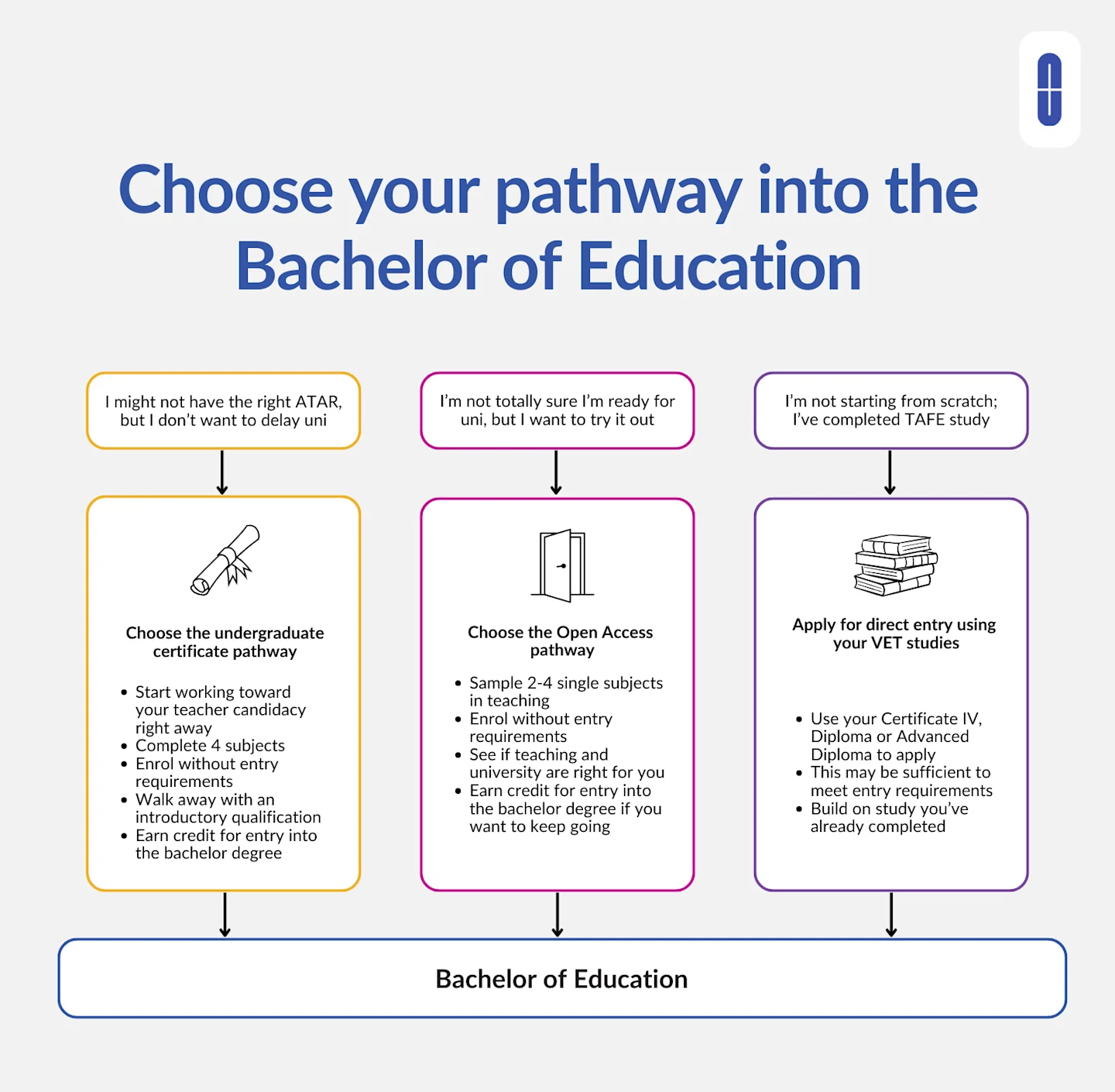
Pathway 1: Start with an undergraduate certificate
Best for: Those who don’t want to delay university and are ready to apply
This is usually the first option I suggest because it’s a direct path into the degree.
You can enrol in the below teaching undergraduate certificates without any entry requirements. The four subjects you complete are from Curtin University’s Bachelor of Education, and count towards it.
What to choose:
- For early childhood or primary teaching: Undergraduate Certificate in Teaching Education Studies
- For secondary teaching: Undergraduate Certificate in Secondary Teaching Education Studies
Why select this pathway:
Once you finish your chosen certificate, you’re eligible to apply for admission into the bachelor degree.
I’d argue this is the best choice for first-time uni students, because it lets you work towards your goals right away, but you can find out if teaching is actually right for you before you commit to the full four-year degree.
What to keep in mind:
Curtin University’s Bachelor of Education is accredited by the Teacher Registration Board of Western Australia and recognised across Australia. Once you complete this qualification, you’ll just need to apply for teacher registration in the state or territory where you’d like to teach.
Pathway 2: Start with Open Access subjects
Best for: Those who are still exploring teaching as an option, and want to ease in one subject at a time
Another option is to start with single subjects from a Bachelor of Education.
Through Open Universities Australia, you can enrol in select teaching degrees this way, instead of meeting the usual entry requirements. You’ll complete two to four subjects from the degree to show you’re ready for university-level study, then transition into the full course.
What to choose:
You’ll find a list of the eligible subjects from under each course’s entry requirements, along with their available study dates. Search the participating teaching degrees.
Why select this pathway:
You want to start small, build confidence, and still earn credit towards a teaching degree.
What to keep in mind:
This pathway can take longer, but some people prefer the extra flexibility so that they can balance study with full or part-time work.
Pathway 3: Use a TAFE qualification
Best for: Those who have some vocational study behind them
If you already have a TAFE qualification, such as a Certificate IV, Diploma or Advanced Diploma, you may be able to use that to apply for a Bachelor of Education directly.
What to choose:
Any Bachelor of Education that offers VET study entry.
Why select this pathway:
It can help you turn previous study into a direct entry option, without starting from scratch.
What to keep in mind:
Every university has slightly different rules around this, so it’s worth checking the entry requirements for the course you’re interested in.

How Helene started her teaching degree without an ATAR
I speak to a lot of future teachers who worry that their ATAR (or lack thereof!) will hold them back. Helene’s story shows that it doesn’t have to.
She’s an Australian citizen who completed her final two years of school overseas, which meant she didn’t receive an ATAR.
Instead of giving up on teaching, she started with an undergraduate certificate before transitioning into a Bachelor of Primary Education. Now she’s on her way to finishing the degree.
Watch Helene share her story.
Tips on choosing the right teaching degree for you
When students ask me how to choose between teaching degrees offered by different unis, I usually tell them to look beyond the course title. A few small differences between courses can have a big impact on your experience.
- Look closely at the subjects in the course. Two Bachelor of Education degrees can include very different topics and electives. I always suggest reading through the subject list so you know what you’ll actually be studying over the next few years.
- Check how teaching placements are structured. All teaching degrees include classroom placements, but the timing and number can vary. Some start earlier in the course, while others are more concentrated later on.
- Make sure the course leads to teacher registration. This is an important one. The degree needs to meet the requirements to register as a teacher in your state or territory after you graduate. We can advise you on this. As a not-for-profit, our uni advice is unbiased and free.
Remember: your ATAR isn’t the only path into teaching
Whether you do go straight into a Bachelor of Education or start through another pathway, there are multiple ways to reach the classroom.
If you’d like one-on-one help figuring out what comes next, you can always book a free consultation with me or another student advisor. We’ll walk you through which options could work for you.
Sometimes, your first step means just starting the conversation.
The ATAR information in this guide is current as of May 2026, but is subject to change.
About the author

Joshua Paleologou
Student advisor specialising in education and teaching courses
Joshua is our specialist in education and teaching courses at Open Universities Australia. As a student advisor, he’s often the first voice aspiring teachers hear when they reach out for guidance on teaching courses.
FAQs about teaching ATARs
Are all courses listed here available through Open Universities Australia?
No, not all. We've included ATAR information about all Bachelor of Education courses available in Australia for thoroughness. But we specialise in advising you on studying this qualification with the following universities:
- Australian Catholic University
- Curtin University
- Edith Cowan University
- La Trobe University
- Southern Cross University
- University of New England
- University of Southern Queensland
You’ll find quick links to their courses throughout this guide.
Check our universities page for a full and up-to-date list of the universities we are partnered with.
Is the ATAR higher for secondary teaching than primary?
Not usually. At most universities, the ATAR is the same for both primary and secondary teaching degrees.
However, it can sometimes be slightly higher for one specialisation. This usually happens if the university has fewer places available in that course, which makes it more competitive.
Another reason you might see a higher ATAR for secondary teaching is when it’s offered as part of a double degree. At some unis, you’ll study a Bachelor of Arts or Bachelor of Science to build expertise in your teaching subject, before completing a Master of Teaching. Because these programs combine two qualifications, they often have higher ATAR requirements.
Should I do a Bachelor of Education or a bachelor degree plus a Master of Teaching?
It really depends on the kind of teacher you want to become and how direct a path you’re looking for.
If you already know you want to be a teacher, a Bachelor of Education is usually the most straightforward option. It combines teaching theory, subject knowledge and classroom placements in one degree, so you can move straight into teacher registration once you graduate.
The bachelor degree plus Master of Teaching pathway is a bit different. You first complete a degree in a specific subject area, like arts, science or maths, and then follow it with a two-year Master of Teaching to qualify as a teacher. This option can be a good fit if you want deeper expertise in a subject or if you decide to move into teaching later in your studies.
When students ask me which is better, I usually say the Bachelor of Education is the simpler route. But if you’re passionate about a particular subject and want to specialise in it first, the masters pathway can work really well too.
Do I need specific Year 12 subjects to study teaching?
Often, yes. Many universities expect applicants to have completed Year 12 English, and some also require Mathematics, particularly for primary teaching degrees.
The exact prerequisites vary between universities, so it’s always worth checking the entry requirements for the course you’re interested in. If you didn’t study these subjects at school, there are enabling courses that can help you meet the requirement.
What is the minimum ATAR for teaching degrees in 2026?
From the 2026 course data I’ve looked at, the lowest ATAR for a teaching degree is 50.0. That’s for some early childhood education courses.
Most primary and secondary teaching degrees sit a bit higher, often around 60.0 to 70.0, depending on the university and how competitive the course is.