Psychology registration pathways explained
By Bec CavalôtPublished on
If you’re considering a career in psychology, the registration process can feel confusing. The good news is that once you understand the steps, it becomes much easier to navigate. This guide explains how psychology registration works in Australia.
How do you become a registered psychologist in Australia?
To become a registered psychologist, you’ll need to complete psychology qualifications accredited by the Australian Psychology Accreditation Council (APAC), followed by one of two approved registration pathways:
- Higher Degree Pathway
- 5+1 Internship Pathway
Both pathways lead to the same destination – general registration, which allows you to practise as a psychologist.
Importantly, your registration pathway is separate from how you study. Whether you study online, on campus or through a combination of both, the registration requirements remain the same.
What is psychology registration?
Registration is the formal approval that allows you to practise as a psychologist in Australia. It ensures every psychologist has completed the education, training and supervision needed to work safely with clients. Registration:
- allows you to use the protected title ‘psychologist’
- confirms you’ve completed approved education and training
- helps ensure psychologists meet professional and ethical standards.
Registration vs studying psychology: what's the difference?
One of the biggest sources of confusion is the difference between studying psychology and becoming a registered psychologist. They're closely related, but they're not the same thing.
Studying psychology | Registration |
Completing university study | Professional approval to practise as a psychologist |
Builds your skills and knowledge | Allows you to use the title ‘psychologist’ |
One step towards becoming a psychologist | Allows you to practise as a psychologist |
Understanding provisional vs general registration
Completing your degree is a major milestone, but graduation from a psychology degree doesn’t automatically lead to registration. Instead, most graduates first move into provisional registration while they complete the final stage of training.
There are two levels of registration in Australia, both issued by the Psychology Board of Australia (PsyBA).
Provisional registration
This is a training phase for psychology graduates, usually after completing the required 4-year psychology sequence. Provisional registration allows you to complete the supervised training required for general registration.
General registration
General registration is the endpoint of the registration journey, usually after completing 6+ years of approved education and training.
It allows you to practise independently as a psychologist.
Registration levels at a glance
Registration type | What it means |
Provisional registration | Completing approved training requirements |
General registration | Eligible to practise as a psychologist |
Who regulates psychologists in Australia?
Psychologists in Australia are regulated by the PsyBA in partnership with the Australian Health Practitioner Regulation Agency (Ahpra). Together they set registration standards, assess applications, maintain the national register and deal with complaints.
Choosing your psychology registration pathway
Once you've completed your psychology studies, you'll need to choose a pathway to general registration. While the two pathways look different, both lead to the same destination: becoming a registered psychologist.
Your career goals, learning and specialisation preferences, academic achievements and pathway availability will all influence which pathway is right for you.
As Dr Annabel Marsh, registered psychologist, lecturer and online course facilitator at Adelaide University, explains:
I don’t think there’s one pathway that’s right for everyone. The best choice depends on your personal circumstances and where you want your career to take you.
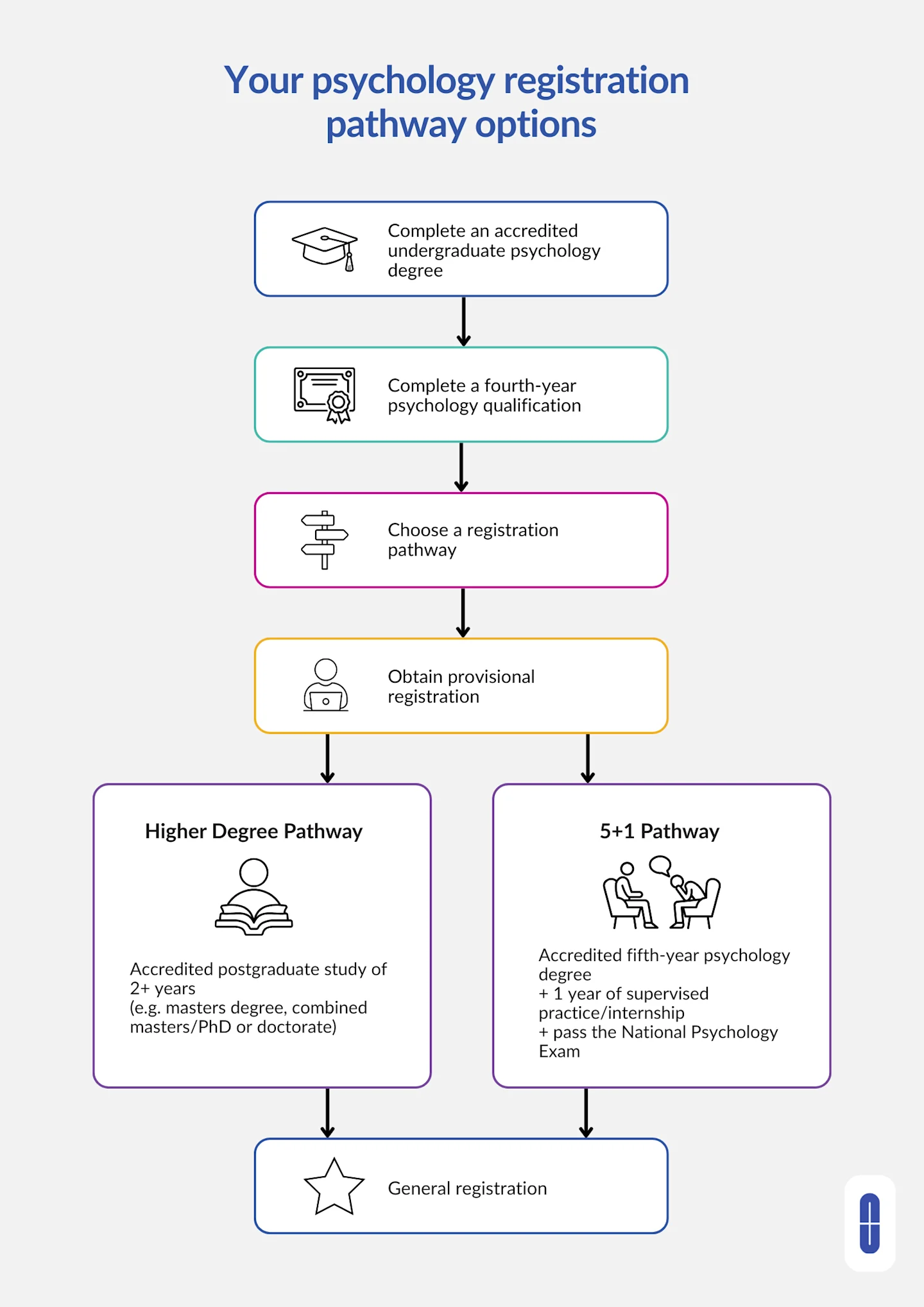
Here's a closer look at what each pathway involves, and who it may suit.
Pathway 1: Higher Degree Pathway
If you enjoy learning in a university environment and want your supervised training built into postgraduate study, the Higher Degree Pathway could be a good fit.
It involves completing an approved postgraduate psychology qualification, such as a 2-year masters degree or a 3- to 4-year doctorate or a combined masters/PhD.
This pathway may suit you if you:
- enjoy structured university learning
- would like your supervised training to be delivered through a university program
- are interested in specialised psychology training
- have strong academic results and are ready for further postgraduate study.
Things to consider:
- postgraduate entry requirements can be competitive
- you’ll need to commit to at least 2 more years of study.
- it includes supervised practice and written case studies before general registration.

Pathway 2: The 5+1 Pathway
If you enjoy learning by doing, you might prefer the 5+1 Pathway This pathway combines a fifth year of study with one year of structured supervised practice.
Unlike the Higher Degree Pathway, you'll complete your supervised training in an approved workplace setting and must pass the National Psychology Exam before applying for general registration.
This pathway may suit you if you:
- prefer combining study with workplace learning
- enjoy learning through practical experience
- are comfortable organising an approved supervised practice position
- would like to build professional experience while completing your training.
Things to consider
- you'll need to secure a suitable supervised practice position
- you'll need to meet supervision and professional development requirements throughout your internship
- you'll need to pass the National Psychology Exam before applying for general registration.
Still weighing up your options? This quick comparison can help you decide which pathway may suit you best.
Which psychology registration pathway is right for you?
Choose the Higher Degree Pathway if you...
✔ enjoy structured university learning
✔ would like your supervised training to be completed through a postgraduate program
✔ are interested in specialised psychology training
✔ meet postgraduate entry requirements.
Choose the 5+1 Pathway if you...
✔ prefer learning through practical experience
✔ want to combine study with supervised workplace learning
✔ are comfortable securing an approved internship
✔ enjoy building professional experience while you train.

Still getting your head around the overall journey? Our guide on how to become a psychologist explains the complete pathway from your first psychology qualification through to registration.
Wondering how long the journey usually takes? Read our guide to typical study timelines and what can affect them.
Can you study psychology online and still become registered?
Yes. Where you study doesn't affect your registration pathway. What matters is that you:
- choose an APAC-accredited online psychology course
- meet all course requirements
- complete any required placements or practical components
- follow an approved registration pathway.
Want to know what online psychology study looks like in practice? Our how to study psychology online in Australia guide explains course delivery, placements and how online learning compares with studying on campus.
Whatever pathway you choose, experience makes all the difference
No matter the pathway, Dr Ross Hollett, Senior Psychology Lecturer at Edith Cowan University, has one piece of advice for every aspiring psychologist: gain experience wherever you can.
Everyone graduates with the same qualification. What really helps you stand out is showing how you've taken what you've learned and applied it in real-world settings – and that can be achieved through either pathway.
Remember, every registered psychologist once stood exactly where you are now – and every pathway begins with taking that first step.
If you're still deciding how to begin your psychology studies, our pathways into psychology degrees guide explores easy entry options for school leavers, career changers and mature-age students.
Explore your study options through us
Compare online psychology qualifications from leading Australian universities and see where each one fits within the psychology registration pathway.
If you'd like help understanding your options, try Help Me Choose or speak with a student advisor for guidance on study pathways and entry requirements.
About the author

Bec Cavalôt
Contributor
Bec Cavalôt is a Melbourne-based writer with more than 20 years’ experience across education, health, wellbeing and lifestyle. When she’s not creating engaging content, you’ll find her practising yoga, enjoying good coffee with friends, walking her dog along the beach or cheering on her kids from the basketball sidelines.
FAQs about psychology registration
Can I call myself a psychologist before I'm registered?
No, you must have general registration to use the title of ‘psychologist’ in Australia.
What's the difference between accreditation and registration?
Accreditation applies to university courses and programs, while registration applies to the individual psychology practitioner.
What happens if I don't get into psychology honours?
Depending on your circumstances, you may be able to complete an alternative fourth-year psychology qualification.
If registration is no longer the right fit, remember that psychology also opens doors to careers in areas such as human resources, community services, marketing and research.
Our psychology jobs and career pathways in Australia guide explores some of the many career options available with a psychology degree.
Can I apply for provisional registration if I completed my fourth year several years ago?
Yes, provided your 4-year accredited psychology sequence was completed within the last 10 years. If you’re unsure, check with the PsyBA.
Can I become a psychologist with a counselling degree or social work degree?
Not directly. Because ‘psychologist’ is a protected title, you must complete an accredited sequence of study. Your counselling or social work degree can serve as a stepping stone, but you will need to undertake additional bridging studies and supervised training to meet registration requirements
Can I complete supervised practice with any employer?
No, you cannot complete supervised practice with any employer. Your work role, practice setting and supervisor must all be officially approved by the PsyBA before you begin your practice.
Can overseas psychology qualifications lead to registration in Australia?
Possibly. Overseas qualifications must be assessed by the PsyBA before you can become registered in Australia. Additional study or training may also be required.