Can early childhood educators teach in primary schools?
By Joshua PaleologouPublished on
We asked Joshua Paleologou, our student advisor specialising in education and teaching courses, whether you can teach in both a primary school setting and a daycare setting once you’re qualified.
Can early childhood teachers work in primary schools?
This is a common question I get asked by students. The answer is: sometimes, but it depends on your qualification.
If you hold a Bachelor of Education (Early Childhood), you’re qualified to teach children from birth to age 5. To teach in an Australian primary school, you’ll need a Bachelor of Education (Primary) or a dual early childhood and primary degree, which extends your scope to teach from birth all the way up to age 12.
Some early childhood degrees also cover children up to age 8, which can open up opportunities in the early years of primary school (Kindergarten/Prep to Grade 3). This varies between universities, so always check the details before enrolling, or better yet chat with a student advisor like me by booking a consultation.
If you’re unsure whether a qualification makes you eligible for primary teaching, this is your reminder to reach out. The team here at Open Universities Australia and I help students compare courses and confirm registration requirements for their state before they commit to study every single day. My passion in particular is education courses, so you’re in good hands.
Learn more: How to become a primary school teacher
Choosing the right degree for your teaching goals
To guide you, here’s a breakdown of the main qualifications that lead into early childhood or primary teaching.
Qualification | Duration | Who it's for | Teaching age range | Where you can work |
|---|---|---|---|---|
3-4 years full time | Those who want to specialise in the early years only | Birth to 5 years (sometimes up to 8) | Early learning centres | |
4 years full time | Those who want to teach primary school only | Ages 6-12 | Primary schools | |
4 years full time | Those who want the flexibility to move between early learning and primary schools | Birth to 12 years | Early learning centres Kindergartens | |
2 years full time | Those making a career change into early childhood teaching | Birth to 5 years (sometimes up to 8) | Early learning centres | |
2 years full time | Those making a career change into primary school teaching | Ages 5–12 | Primary schools | |
2 years full time | Those making a career change who want to double their teaching options | Birth to 12 years | Early learning centres Kindergartens |
*Depending on the age range your qualification covers
What each qualification means for you
Bachelor of Education (Early Childhood)
This degree is perfect if you want to specialise in the early years, guiding children as they take their first steps into learning and socialising. Some universities design their programs to include children up to age 8, so check the course outline closely if you’d like the option to teach in junior primary school.
Bachelor of Education (Primary)
This is the go-to qualification if your goal is to teach across the full range of primary school subjects, from literacy and maths to art and science. You’ll learn how to design engaging lessons, manage classrooms and build confident, curious learners aged 5 to 12.
Bachelor of Education (Early Childhood and Primary)
If you’re torn between the two, this combined degree gives you the best of both worlds, allowing you to register as an early childhood or primary teacher once you graduate. It takes the same amount of time as a single Bachelor of Education, but it doubles your career options. The key difference is that there are often no electives, and you’ll need to complete your placements across both teaching settings.
Master of Teaching (Early Childhood)
This postgraduate qualification is for those who are already qualified in another field, but want to make a career change into early childhood teaching. It covers the same age range as the bachelor degree (birth to 5, or sometimes up to 8), but it takes into consideration your years in the workforce and also focuses on leadership training. It can open the door to early childhood centre management or policy development roles as well as teaching.
Master of Teaching (Primary)
Already working in early childhood education or coming from another career altogether? This postgraduate qualification lets you pivot into primary teaching in just two years. You’ll cover classroom management, curriculum planning and how to support diverse learners – skills that transfer seamlessly from your early learning experience.
Master of Teaching (Early Childhood and Primary)
Just like the bachelor degree, this dual qualification widens your options by allowing you to teach both early childhood and primary school students. It's a faster path to take for those who already have an undergraduate qualification, since it can be finished in two years.
Early childhood vs primary school classrooms: what to expect
If you’re feeling stuck choosing between early childhood and primary teaching, it helps to picture what your days might look like in each environment. Both roles make a big impact on children’s lives. They just do it in different ways.
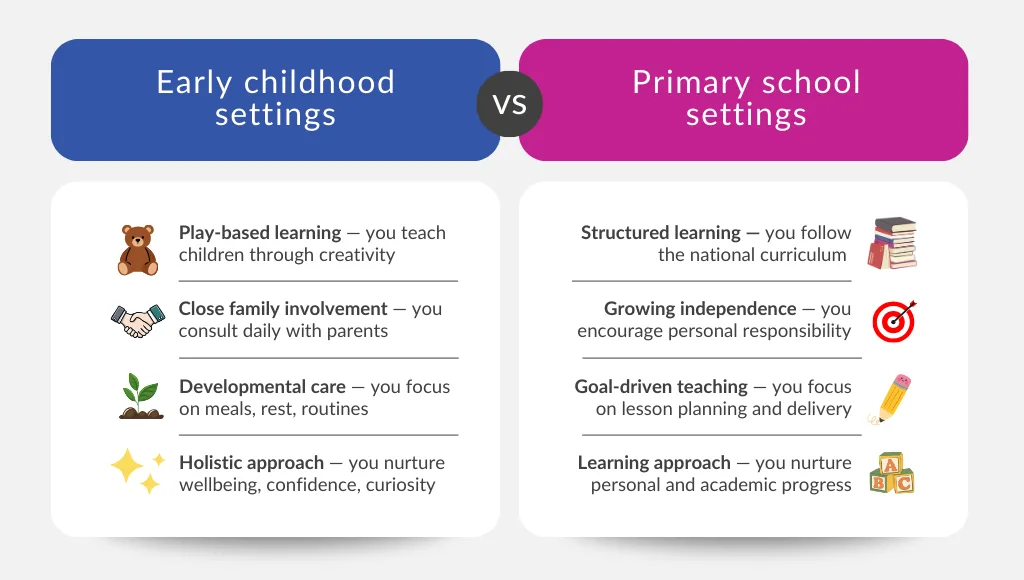
Early childhood settings
This includes long daycare centres, kindergartens and preschools.
What to expect day-to-day:
- A focus on learning through play
You’ll help children explore the world through stories, art and hands-on experiences. - Close relationships with children and families
You’ll get to know each child and their families personally as you see them at many different hours of the day and week, including mealtimes. - A balance of care and education
You’ll support children’s social, emotional and language development while guiding daily routines like meals and toileting. - Holistic teaching
You’ll focus on the whole child — their wellbeing, confidence and curiosity. While school teachers have a heavy focus on academic outcomes, your teaching will embody many more elements.
Primary school settings
This includes public, private, independent and religious schools.
What to expect day-to-day:
- A focus on structured learning
You’ll be in charge of planning and executing lessons designed around the national curriculum — from literacy and numeracy to science, history and the arts. - More behavioural independence from students
You’ll be teaching students who are learning to think critically and take responsibility for their work, so lessons are more formal and goal driven. - Greater student to teacher ratio
You’ll often lead a class of 18 to 30 students, guiding them through a mix of subjects across the week. - An emphasis on academic and personal growth
Your time will be devoted to lesson planning, teaching and student wellbeing, as opposed to meal times, toilet training and similar.
If you thrive on planning, structure and supporting academic growth through a set of curriculums and systems (while flexing your creativity and empathy within those bounds) primary teaching might be your calling.
Meanwhile, if you’re more drawn to the emotional and social needs of young children as they grow, early childhood could be where you shine.
How to transition from early childhood to primary teaching
Many of the students I speak with start in early childhood before moving into primary teaching. It’s absolutely possible to make the jump.
Here’s what you need to do:
- Check your current qualification
Start by confirming the age range your completed qualification covers. If it only allows you to teach children from birth to age 5, you’ll need to enrol into a program that meets primary teaching standards. - Choose the right postgraduate degree
For most people, the next step is a Master of Teaching (Primary). It’s the fastest option, allowing you to finish in two years. Most universities even let you enrol directly based on your existing degree. - Register to teach
Once you complete your new qualification, you’ll need to apply for teacher registration with your state or territory’s authority. - Get personalised advice
If you’re unsure which course suits your background, book a free consultation with one of us at Open Universities Australia. We’ll walk you through the options and help you find a degree that fits your experience, lifestyle and goals.
Ready to start your teaching career?
Build a rewarding future inspiring the next generation.
About the author
Joshua Paleologou
Student advisor specialising in education and teaching courses
Joshua is our specialist in education and teaching courses at Open Universities Australia. As a student advisor, he’s often the first voice aspiring teachers hear when they reach out for guidance on teaching courses.
FAQs about early childhood degrees
What age group does an early childhood qualification cover?
Most early childhood education qualifications cover birth to five, though some extend to age eight. Legal requirements for starting school differ from state to state, but most Australian children are enrolled in primary school before their sixth birthday.
Can I teach primary school with an early childhood degree in Australia?
You may be able to teach up to Grade 3 if your qualification allows it. Otherwise the answer is no. To teach all years in an Australian primary school, you’ll need a primary teaching degree or a dual early childhood and primary qualification.
How can I upgrade my early childhood education qualification to teach in schools?
If you hold a bachelor degree, you can typically enrol in a postgraduate qualification like a Master of Teaching (Primary) right away. Some states allow teachers with a graduate diploma to teach on a provisional basis.
Check the specific requirements of your state before deciding what type of course to pursue.
Does registration differ by state for teaching in schools?
Yes. You’ll need to register with your state or territory’s teaching authority:
State | Teaching body |
|---|---|
NSW | |
Victoria | |
Western Australia | |
Tasmania | |
Northern Territory | |
Queensland | |
Australian Capital Territory | |
South Australia |
For a free, unbiased chat about weighing up options to become an early childhood educator or primary school teacher, book a consultation with myself or one of my colleagues.
We’re here to help you make the right decision for your goals, and can even get you enrolled over the phone. I hope to speak with you about your teaching goals soon!