Counselling salaries in Australia: how much can you earn?
By Sarah VercoePublished on
Get an honest look at what counsellors earn in Australia, including average salaries and the factors that can influence your pay.
What is the average salary for a counsellor?
Counsellor salaries vary depending on your experience, location, specialisation, and whether you work in the public, private or community sector. As a guide, Jobs and Skills Australia reports a median full-time salary of around $112,000 a year, while SEEK estimates average salaries for advertised roles are $95,000 to $105,000 a year.
Like all fields, entry-level counsellors typically earn less, while experienced practitioners can earn quite a bit more, especially if they’re running a successful private practice or working in specialised clinical roles. And while the path to higher earning exists, it can take a little while to get to the end.
What factors affect a counsellor’s salary?
There are plenty of variables when it comes to what you can earn as a counsellor. Here’s a look at some of the most common.
Experience
Like most roles, a counsellor’s salary tends to rise with years of practice. Senior counsellors and clinical leads will earn more than early-career counsellors.
Qualifications
Higher-level qualifications can improve earning potential in counselling. A postgraduate qualification, particularly a Master of Counselling, combined with registration through a professional body such as the Psychotherapy and Counselling Federation of Australia or Australian Counselling Association, may open the door to higher-paying roles and support higher fees in private practice.
This is reflected in employer expectations. A 2023 analysis of SEEK job ads found that more than half of counselling roles required a degree-level qualification, while just over 30% required registration with a professional body.
Find out more about the qualifications needed to become a counsellor.
Location
Salaries are generally higher in cities, though regional and remote roles might attract loadings or incentives like salary packaging and relocation grants to help level out workforce shortages.
Sector
Government and public health roles tend to offer structured pay scales with reliable progression, while counsellor pay rates in the community sector vary widely. Private practice income depends almost entirely on caseload, fee structure and business development effort.
Specialisation
Some specialisations attract higher fees or higher demand, such as trauma, rehabilitation counselling and EAP work.
Learn more about the different counselling specialisations.
Employment arrangement
Employed counsellors have stable incomes with super and leave entitlements, while self-employed or private practice counsellors have to find a balance between risk and higher earnings.
Counselling salaries by experience level
Counsellor salaries tend to increase with experience, though years in the profession aren't the only factor that affects earning potential.
Qualifications, professional registration, specialisation, leadership responsibilities, industry and whether you work in private practice can all influence how much you earn.
The salary ranges below are indicative of advertised counselling roles on SEEK and should be used as a guide rather than a guaranteed salary at each experience level.
Entry level (0 - 2 years)
Graduate and entry-level counselling roles advertised on SEEK commonly start from around $65,000–$80,000, particularly in community services, youth work, and non-profit organisations.
Mid-career (3 - 7 years)
With experience and registration, many counsellor roles are advertised in the $85,000 - $100,000 range. Counsellors may begin to take on more complex caseloads, move into senior practitioner roles, or begin building a private practice alongside employed work.
Senior and specialist (8+ years)
Experienced counsellors may move into senior practitioner, specialist, leadership or clinical supervision roles, where salaries are advertised at around $100,000 or more.
Counsellors who run a thriving private practice are free to set their own fees without a ceiling, though the trade-off is a less predictable income.
Counselling salaries by state and territory
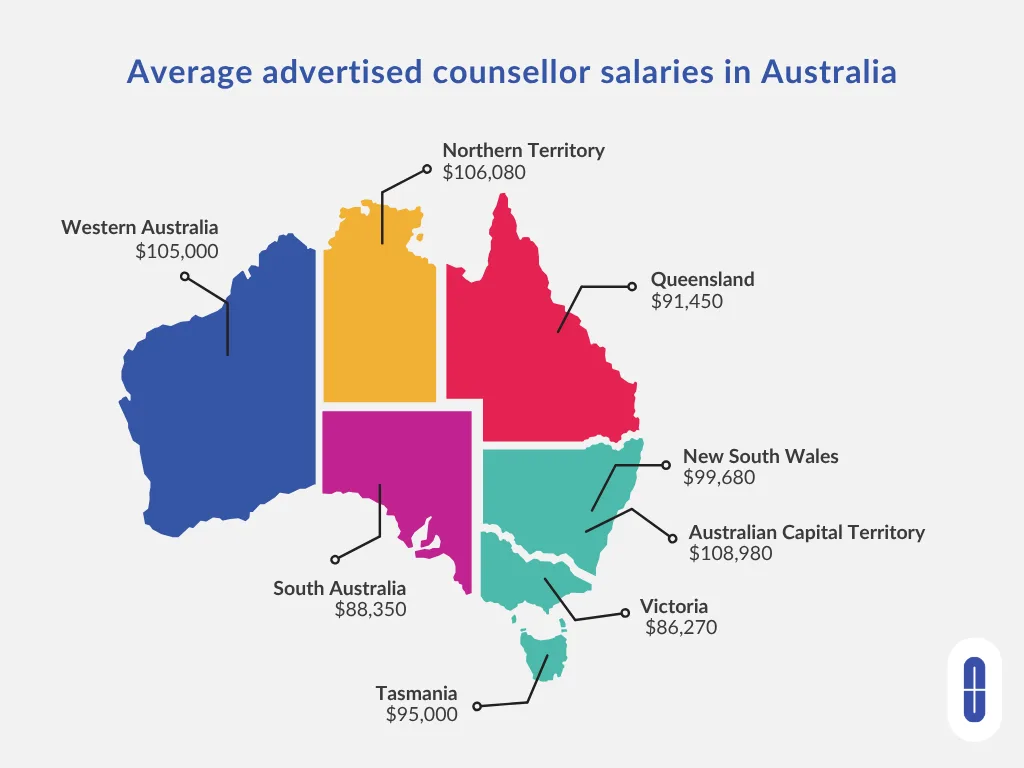
New South Wales
At the time of publishing in August 2026, the average advertised salary for NSW counselling jobs on SEEK is $99,680. With a large concentration of roles across Sydney and major regional centres, counsellors can find opportunities in healthcare, community services, education and private practice.
Victoria
The average advertised counsellor salary in Victoria is $86,270. Victoria offers strong employment opportunities across community health, mental health services and the private sector.
Queensland
Average advertised Queensland counsellor salaries sit at $91,450. The demand in this state is strong, particularly in community and regional settings.
Western Australia
The average advertised counsellor salary in Western Australia is $105,000. Remote and regional loadings can help tip the scale though, pushing earnings higher for those willing to work outside of Perth.
South Australia
The average advertised salary for counsellors in South Australia is $88,350. Opportunities in mental health services in this state are only growing.
Tasmania
Advertised counselling salaries in Tasmania average $95,000. While pay varies by role and employer, Tasmania’s comparatively lower cost of living than some larger Australian cities may also help salaries stretch further.
Australian Capital Territory
The ACT has a higher cost of living, so on average the salaries are higher too. According to SEEK, the average advertised counsellor salary in the ACT is $108,980.
Northern Territory
There are significant workforce shortages in mental health and community services in the NT, which creates strong demand and, in some cases, incentives. Here, the average advertised counsellor salary is $106,080.
Counselling salaries by specialisation
Specialising can expand your career options and, in some cases, increase your earning potential.
In a study of 70 SEEK counselling ads, 62.8% used a specialist job title and only one role was described as generalist. While the data was collected in 2022, it suggests specialist expertise is valuable when applying for counselling roles.
Trauma counselling
Trauma-informed practice is a growing counselling field, and counsellors with additional training in approaches such as EMDR, Havening Techniques or somatic therapies may have access to a wider range of roles or be able to charge higher fees in private practice.
In the same study referenced above, trauma counselling was the most frequently mentioned area of expertise, appearing in 41% of roles.
Rehabilitation counselling
Rehabilitation counsellors often work with insurers, employers and compensation schemes. This counselling field has its own professional registration pathway through the Australian Society of Rehabilitation Counsellors, and those additional requirements can be reflected in salary outcomes. SEEK currently puts average advertised salaries at $90,000 - $100,000.
Employee Assistance (EAP)
EAP counsellors provide short-term counselling for employees experiencing personal or work-related challenges.
While there isn’t clear Australian salary data for this specialisation, the Employee Assistance Professional Association of Australasia claims counselling is the most accessed employee assistance service. That level of use may support competitive earning potential through specialist providers and workplace wellbeing programs.
Drug and alcohol counselling
Demand remains strong across government, community and private rehabilitation services, with salaries depending on the employer and the complexity of the role. Current roles on SEEK advertise salaries between $75,000 - $85,000.
Child and adolescent counselling
Counsellors working with children and young people may be employed in schools, community organisations or private practice. School-based roles are often paid under education sector agreements, which can provide structured salary progression. This varies by state.
For example, NSW government school counsellors currently earn between $101,122 and $160,983, depending on their classification. Private practice income, meanwhile, depends on client demand and the fees charged.
Private practice (any specialisation)
Regardless of specialisation, private practice generally offers the highest earning potential, but it also comes with the greatest financial uncertainty.
Registered counsellors commonly charge between $120 and $200 or more per session, although building a sustainable client base can take time.

How can counsellors increase their earning potential?
Build experience and get registered
When it comes to earning potential, experience counts. As counsellors build their skills, complete further study, and register with professional bodies, such as PACFA or the ACA, they're able to explore a wider range of roles and opportunities.
Develop a specialisation
Building expertise in a particular counselling field can help you stand out. Whether it's trauma, addiction, grief or workplace wellbeing, having a clear area of focus can make it easier for clients to find you and may allow you to charge higher fees in private practice.
Move into private practice
Private practice can offer the highest earning potential, but it also means running a business and some income uncertainty. Building a client base takes time too, and income is often less predictable in the early years.
Take on leadership supervision
Experienced counsellors may move into senior clinical, team leader or supervisory positions. Some also provide clinical supervision to other counsellors as part of their work.
Diversify your work
Not every counsellor relies solely on client sessions. Some also run workshops, facilitate groups, develop online courses or teach, which is a great way to diversify work and income alongside regular counselling practice.
Look beyond cities
Regional and remote Australia continues to need mental health professionals, and depending on the role and employer, these positions may come with higher salaries or other incentives.
Real talk: a counsellor shares their salary journey
Jane Kennedy, a Sydney-based counsellor, came to counselling after careers in church ministry and international humanitarian work. She retrained and gradually built a private practice specialising in religious trauma and rebuilding identity.
Building my niche and my private practice took about a year and I saved a buffer to support about four months of my expenses beforehand. I also worked part-time for a crisis line during that year, both for the experience and so I could build my practice gradually.
She describes the first year of practice as a steep learning curve. “Like any small business there are sharp learning curves, and I threw everything I could at it to make it work.”
Today, she combines client work with online courses and groups for other counsellors. “I love the freedom I have to work hours that suit me and create workflow I'm energised by.”
She says she believes building a sustainable income comes down to more than clinical skills alone. “Counsellors can absolutely earn a good income with the commitment to best practice in our work with clients, but also in showing up consistently to promote our work and let people know how to find us.”
Explore counselling courses through us
If the earning potential and career pathways in counselling appeal to you, the next step is finding a course that will get you there. Discover the online counselling courses that are available through Open Universities Australia.
Or if you’re still weighing up your options, try Help Me Choose for personalised course recommendations.
About the author

Sarah Vercoe
Contributor
Sarah Vercoe is a Queensland-based writer bringing lifestyle, education, and human-interest stories to life for national publications and non-profits. When she’s not writing, she’s lost in a book with her cat by her side.
FAQs about counselling salaries
What type of counsellor gets paid the most?
Income depends on your experience, where you work, whether you're employed or self-employed, and whether you've developed a specialisation. Counsellors in private practice generally have the highest earning potential, while rehabilitation and employee assistance (EAP) roles can also offer competitive salaries.
Who earns more: counsellors or psychologists?
Psychologists generally earn more, particularly those who are registered to provide Medicare-funded services. That's largely due to their longer training pathway and broader scope of practice. Experienced counsellors in private practice or specialist roles, however, can also build a strong income.
Read more about the differences between counsellors and psychologists and what psychologists earn.
What employee benefits do counsellors usually receive?
That depends on where you work. Employed counsellors typically receive superannuation, paid annual and personal leave, professional development opportunities and clinical supervision. Some government and community sector roles also include salary packaging. If you run your own private practice, you'll need to cover these costs yourself.