Is a criminology degree worth it in Australia?
By Sarah VercoePublished on
A criminology degree can take you well beyond the obvious – into cybercrime, policy, research, fraud, corrections and more. Along the way, you’ll learn to question assumptions, untangle complex problems and see crime and justice in a whole new light.
Is a criminology degree worth it?
Studying criminology can be worth it if you’re genuinely curious about why people offend, and you want to launch a career dedicated to exploring how society responds.
Criminology is a career path that suits people who are comfortable sitting with complexity instead of needing a tidy answer, and who believe understanding crime can lead to better outcomes for society.
It’s also a steadier bet than many other careers. “In times of financial trouble, there are certain industries that remain relatively stable for employment and opportunities, and criminal justice is one of them,” explains Dr Wayne Petherick, a criminologist and lecturer from the University of Southern Queensland with close to three decades in the field.
Whether it's worth it for you comes down to what you want out of it. If you're chasing one specific job title, criminology might not point you there directly. But if you're willing to follow the skills wherever they lead, you'll find far more waiting for you than you might first expect.
What are the benefits of studying criminology?
It gives you skills that transfer across industries
You'll build research and analysis skills, sharp critical thinking, strong writing skills, and the ability to explain complex ideas clearly. None of that stays locked inside criminal justice. These are skills that can carry you across government, the private sector, and pretty much anywhere someone needs to untangle a problem and explain it well.
It’s a field that holds up when other don’t
Criminal justice doesn’t shrink the way other industries do when the economy dips. “While a lot of industries suffered through COVID, for example, prisons still need to be manned, crimes continue to be committed, and offenders released from prison need to be supervised in the community,” Wayne says.
It opens lots of doors
Graduates end up in policing, courts, corrections, customs and border protection, government policy, community organisations and research. That expanse might feel a bit open-ended at first, but it's exactly what makes this degree work for people whose interests shift as they go.
It encourages a sharper way of thinking about the world
A criminology degree changes how you see crime and justice as a citizen, not just as a future criminologist.
Jeff Ackerman, Program Director of Griffith's School of Criminology and Criminal Justice, says understanding how crime and punishment actually work makes you a more informed member of society, someone who can see past a headline or a slogan to what's really going on.
What are the challenges of studying criminology?
There’s no single path waiting
Unlike nursing or teaching, criminology won't set you up for one defined job. That's part of its strength, but it can feel unsettling if you want a clear, straight line from degree to career.
TV isn’t telling the truth
It’s common for students to enrol expecting profiling, crime scenes and courtroom fireworks. That stuff sits on the edges of the profession at best. Most days look like research, analysis, report writing and communicating findings, which is less cinematic but still solid, useful work.
Study might not stop at a bachelor degree
If you're chasing roles that sit in the higher salary bracket, especially in academia, where senior roles can earn over $150,000 a year, you should expect to keep studying.
More than 80% of university academics have a postgraduate qualification, according to Jobs and Skills Australia, and criminology lecturers are no exception. Think of your bachelor degree as the first step, not the finish line.
What opportunities can studying criminology create?
Graduates end up in law enforcement, courts, corrections, government policy, community services, victim support, research, customs and border protection, and the private sector, so where you land often comes down to what you're drawn to.
And some opportunities aren't obvious from the outside. Insurance and fraud investigation, cybercrime, environmental crime, corporate compliance and international justice are all opportunities that lean on criminological thinking.
Australian Bureau of Statistics data from the last released census shows where criminology degree graduates go on to work, and just how broad the directions can be.
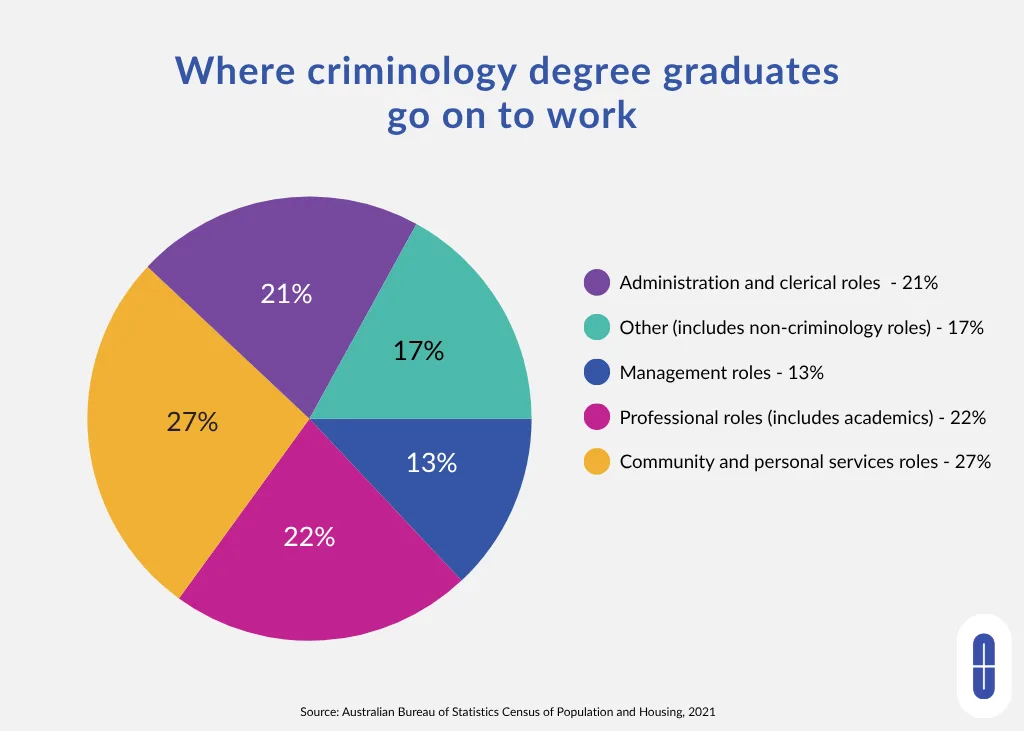
Professionals includes legal, social and welfare professionals, as well as academics. Community and personal services roles includes law enforcement.
Want to learn more about where a degree in criminology can lead? Read our guide to criminology jobs and careers pathways in Australia.
What do people with a criminology qualification earn?
Career options are only one part of deciding whether a degree is worth it. It's also worth understanding how much you can earn and if your degree will pay off financially.
According to Australian Bureau of Statistics Census data (note that updated data will be released in 2027), those working full-time whose highest completed qualification was in criminology fell into the following salary bands:
- Under $52,000: 12%
- $52,000–$77,999: 31%
- $78,000–$103,999: 30%
- $104,000–$155,999: 20.8%
- $156,000+: 6%
That means a sizeable share of workers with a criminology qualification are earning above $100,000.
For more detail on what you could earn at different stages of your career, read our guide to criminology salaries in Australia.

What should you consider before studying a criminology degree?
Before you enrol, here’s how to work out if a criminology degree is worth it for you. Ask yourself:
What do you want the degree to do for you?
If you've got one role in mind, check whether criminology is really the fastest way there, or whether something else suits better.
Are you okay with not having a fixed outcome?
A criminology degree won't hand you a job title on graduation day. It hands you a foundation, and it's on you to build on it. That's exciting if you're up for it, unsettling if you're not.
Do you want to pursue academic or research roles?
If academic or senior research roles are the goal, expect postgraduate study on top of your bachelor degree.
Is it an interest beyond a pay cheque?
“Students who treat a degree like a free pass into the workforce do not tend to do so well as others because they don't appreciate it is the knowledge you acquire through the degree that counts more than the bit of paper marking the journey,” explains Wayne.
It isn't the bit of paper that prepares you for work. It is the educational process and journey that gives you hard and soft skills.
Are you drawn to it for the right reasons?
Plenty of people come to criminology with the wrong picture in their head. If crime scenes and interrogation rooms are what's pulling you in, read up on what the work actually looks like before you sign anything.
Start with our guide to a day in the life of a criminologist.
How can you get started in criminology?
There’s more than one pathway into criminology. Where you start depends on your previous study, your goals and how ready you are to commit to a degree.
You could start with a single subject or shorter qualification to explore the field and build towards further study.
If you’re ready for a full undergraduate degree, you can study criminology on its own or combine it with a related area such as psychology, social work or law.
Do further research with these resources:
- Read about the different criminology degrees to figure out what suits you best
- Compare what’s available with different universities, looking at subjects, fees and start dates
- Understand the entry requirements you need to meet to enrol
- Explore the alternative pathways you can access if you don’t meet those requirements
- Learn about what it’s like to study criminology online
Explore your study options through us
Explore criminology courses online through Open Universities Australia.
We help you choose a course that suits your needs, find a pathway in and enrol; you then become a student directly with your chosen university.
About the author

Sarah Vercoe
Contributor
Sarah Vercoe is a Queensland-based writer bringing lifestyle, education, and human-interest stories to life for national publications and non-profits. When she’s not writing, she’s lost in a book with her cat by her side.
FAQs about criminology degrees
Is a criminology degree worth it if you don't want to work in law enforcement?
Yes. Law enforcement is just one of many sectors where criminology graduates land. Policy, research, community services, corrections, academia and the private sector all hire graduates into roles that have nothing to do with policing.
“From the police to courts to prison to customs and border protection and others, it's a very diverse field,” Dr Wayne Petherick explains.
Is a criminology degree still worthwhile if you don't have a specific career in mind?
Absolutely. If you're willing to be proactive about building experience and following your interests as they show up, you don't need a fixed destination to get value from this degree.
Can a criminology degree complement experience in another profession?
Definitely. People already working in corrections, policing, social work or law often pick up criminology at postgraduate level to formalise what they've already learned on the job.
Can criminology help you develop transferable skills employers value?
Yes. Research, data analysis, critical thinking, report writing and policy evaluation all come out of criminology study, and every one of them travels well beyond criminal justice. You come out of a criminology degree thinking differently about complex problems, and that applies almost anywhere.