Lawyer salaries in Australia: how much can you earn?
By Simon JonesPublished on
Find out how much lawyers earn in Australia, from graduate pay through to partner level, plus a law dean’s refreshingly honest take on chasing the money.
What is the average salary for a lawyer in Australia?
The average lawyer salary in Australia sits between $95,000 and $115,000 a year, according to SEEK, but there are plenty of caveats to that salary band.
Jobs and Skills Australia puts median weekly earnings for solicitors at about $2,070, (roughly $106,100 yearly). Looking at Mahlab’s analysis of private practice firms in Melbourne and Sydney, the average of the typical salaries reported across various experience levels and firm categories is $180,000.
Where you land within (or well beyond) that range depends on your experience, location, specialisation, employer and the type of law you intend to practice in.
To add some real-world perspective to the numbers, we spoke with Professor David Heilpern, Dean of Law at Southern Cross University, a former barrister and magistrate who has watched thousands of graduates thrive in their legal careers.
Want to become a lawyer?
We explain the different routes you can take.
What factors affect a lawyer’s salary?
The biggest reasons are experience and seniority, your area of specialisation, your employer type and size, your location, and whether you’re an employee, a barrister or running your own practice.
One factor David says gets overlooked is the booming government and not-for-profit sector.
“All government departments have legal teams now,” he says. “Local councils have legal teams. Anything from a mid-size to a large charity will have an in-house legal team.” And these roles pay well early on while giving you flexibility that private firms will struggle to match.
Keep in mind that published figures can seriously understate what private practice lawyers take home.
“There are lots of perks in the private sector that hide what the reality of income is,” he says – think firm cars, technology, salary-sacrifice arrangements and bonuses on top of base salary.
Law salaries by experience level
Here’s how earnings can progress over the course of a legal career:
Career stage | Expected annual salary |
Graduate lawyer | $65,000–$80,000 |
Mid-level career lawyer (approx. 1–5 years) | $110,000–$130,000 |
Specialist / senior legal roles | $150,000–$250,000+ |
Partners | $300,000 to $2 million+ at top-tier and specialist firms |
Sources: SEEK advertised salary data and the Mahlab Report 2026.
Bear in mind that government roles can beat those graduate figures comfortably.
“If you get a job at Legal Aid, the base rate to start is about $120,000 a year. The Aboriginal Legal Service has caught up with Legal Aid, and at the DPP you can expect even more as a starting graduate,” David says.
His best advice for new graduates?
There’s just so much flexibility in the government and quasi-government sector that it’s a great first job – a place to find your sea legs, get some experience under your belt, and then decide.
Law salaries by location
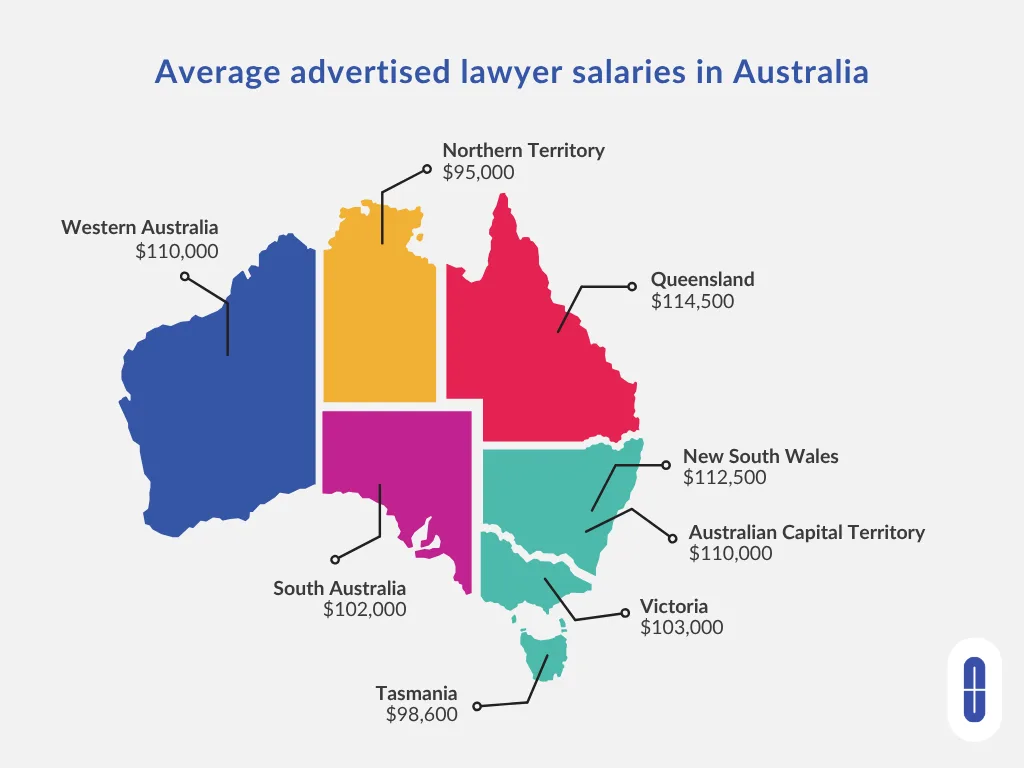
Based on SEEK’s advertised salary data, here’s how average lawyer pay compares around the country.
Queensland
Queensland records the highest statewide average at about $114,500 a year, lifted by strong corporate and regional demand, with Brisbane averaging about $120,000.
New South Wales
New South Wales, home to the country’s biggest concentration of law firms, averages about $112,500, with Sydney’s top-tier and international firms paying well above that.
Australian Capital Territory
The ACT sits at about $110,000, anchored by government, regulatory and policy-heavy legal work in the Australian capital.
Western Australia
WA also averages about $110,000, with Perth commanding premiums in energy, mining and resources law.
Victoria
Victoria averages about $103,000. Melbourne salaries sit a step below Sydney’s at equivalent levels.
South Australia
South Australia averages just under $102,000, with steady demand across family, commercial and government practice in Adelaide.
Tasmania
Tasmania averages about $98,600. It’s a smaller legal market, but regional shortages mean there’s a lot less competition for roles.
Northern Territory
The Territory’s statewide average is about $95,000, but you can expect salaries in Darwin to average much higher because of how hungry the local market is for lawyers.
Regional centres
Don’t assume the big cities always pay best. Regional centres like Bunbury and the South West top SEEK’s location rankings at about $125,000, and David argues the lifestyle perks are higher in the regions too.
If you’re a local solicitor in a country town earning $150,000 or $180,000 a year, you’re living well. The cost of housing isn’t that large, and your kids will be able to buy a house down the road.
Then there’s how you’re treated. One of his graduates recently took her first job in Darwin, where lawyers are scarce.
“She said the most important thing is they don’t want her to leave. They’re looking out for her, checking in with her, making sure she’s not overworked. To me, that’s much more important than getting a job at some named firm.”
Law salaries by specialisation
Your practice area influences your pay packet as much as your postcode. These are SEEK’s average advertised salaries for legal roles:
Role | Average advertised salary |
General counsel | $240,000 |
Legal counsel (in-house) | $150,000 |
Employment lawyer | $145,000 |
In-house lawyer | $130,000 |
Family lawyer | $125,000 |
Property lawyer | $125,000 |
Solicitor | $110,000 |
Barrister (advertised employed roles) | $85,000 |
That barrister figure comes with a huge caveat, though. Because almost all barristers are self-employed, advertised salaries capture only a tiny sliver of the picture. David says:
The average income for an established barrister in New South Wales is between $300,000 and $500,000 a year. I don’t think anyone can complain about that.
He does, however, advise students to beware of high-volume personal injury firms as being “notoriously bad payers” for junior lawyers.
On the flip side, criminal law pays far better than its reputation suggests once you factor in government roles. You can dig into what each field involves in our law specialisation guide.

How can lawyers increase their earning potential?
Here are a few ways you can earn a bigger pay packet as your career progresses:
- gaining experience and moving up through associate, senior associate and partner roles
- specialising in high-demand areas of practice
- moving in-house or into legal leadership positions (e.g. general counsel)
- going to the bar, where established barristers substantially out-earn most salaried roles
- practising in regional and short-staffed markets, where demand pushes packages up
- adding postgraduate qualifications or specialist accreditation
Going to the bar (becoming a barrister) deserves a special mention because the payoff is delayed.
“When you go to the bar, you go from a salary to nothing, and it takes a couple of years to build up,” says David. “But there are very few who, in the medium to long term, would not say they’re better off for doing it.”
His overarching advice, though, is to chase interest before income. "Follow your interests. They may change over time, but don’t do the work you don’t want to do. If you follow your passions and your interests, you can’t fail."
Real talk: David’s own salary ups and downs
David’s career shows that a rewarding track through the law is rarely a straight line up.
He started in private practice, then moved into academia when his children were young, taking roughly a one-third pay cut in exchange for flexibility, school holidays at home and, as he puts it, “never having to send out a bill.”
Becoming a magistrate doubled his academic salary. Returning to university life as Dean of Law two decades later meant dropping about a third again. He says:
There have been three or four times in my career where I’ve taken a drop in salary. In my experience, it always pays off in the medium to long term. But in the short term, there’s pain. Law is not linear like most jobs. Unless you stay with the same employer, there are going to be dips and rises.
Plenty of lawyers do climb one ladder from junior to partner, with each step bringing a pay rise.
But if your priorities change over time – towards family, lifestyle, public service or something else entirely – the profession is flexible enough to change with you.
Explore your study options through us
Browse online law courses from leading Australian universities through Open Universities Australia.
We help you compare your options, find a pathway in and enrol; you become a student with your chosen university.
The salary information in this guide is current as of August 2026.
About the author

Simon Jones
Contributor
Simon Jones is a journalist and editor who’s worked across both print and digital mastheads for two decades. He specialises in finance and technology but produces content across a broad spectrum of Australian industries.
FAQs about law salaries
Do lawyers receive bonuses in addition to their salary?
Sometimes yes, especially in private practice, where performance bonuses and perks like firm cars can add meaningfully to the overall package. Government roles may not offer bonuses, but they do have stronger leave, superannuation and overall flexibility.
Are lawyers paid differently in private practice and government roles?
Yes, although not always in the way you’d expect. Senior private practice ultimately out-earns government, but early on the gap can run the other way.
What is the highest earning lawyer role?
Equity partners at top-tier firms and elite barristers sit at the very summit. Leading silks (senior barristers) can charge thousands of dollars a day, although David says there’s a drawback: “Not all silks get a lot of work – they’re expensive.” For salaried lawyers, general counsel roles top the table at $230,000 to $250,000 on average.